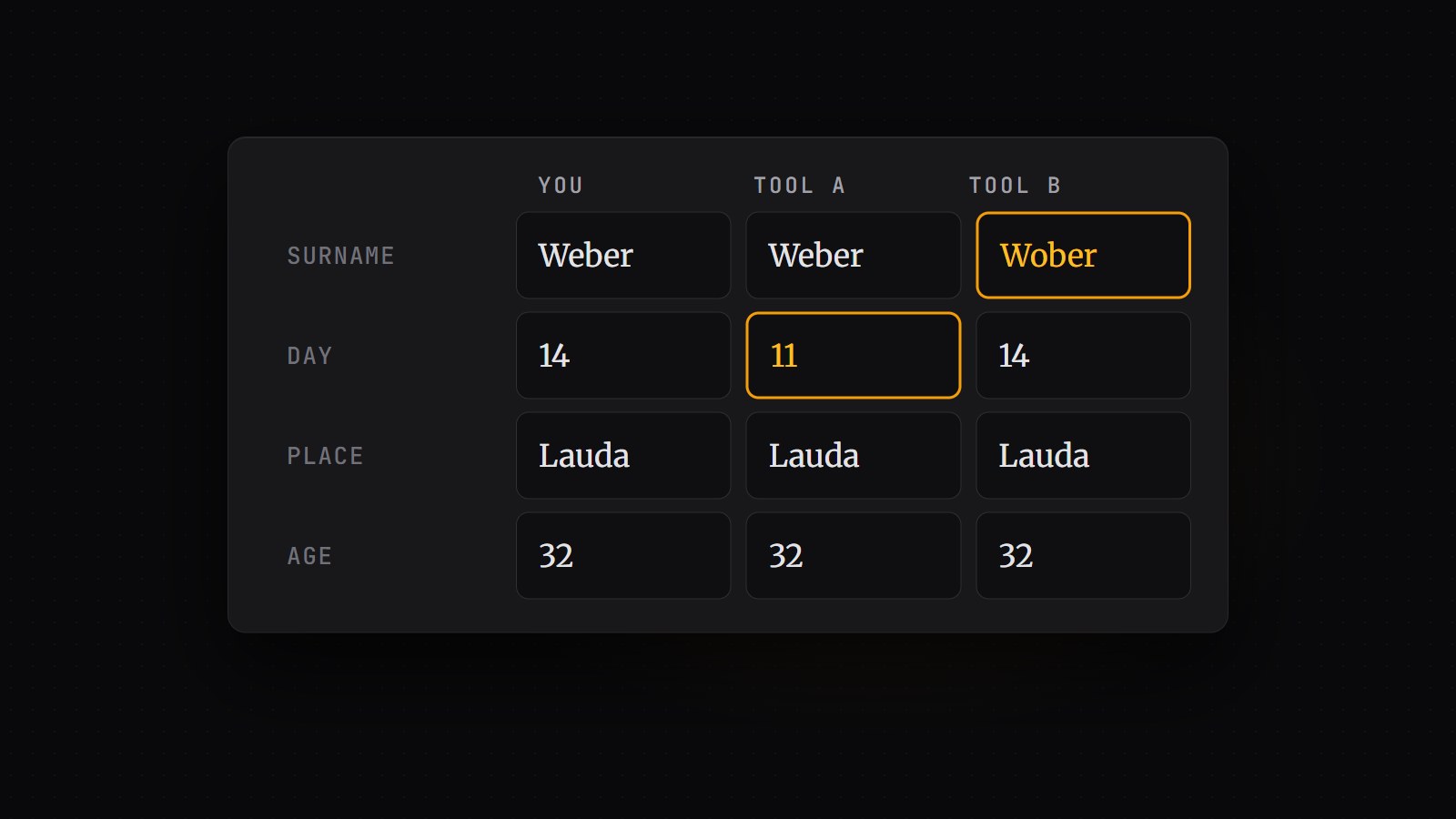
If you have German ancestry, you have probably run into a frustrating wall. You find the record (a birth entry, a church register, a family letter) and you cannot read a single word of it. What is stranger is that fluent German speakers often cannot read it either. The language is German, but the handwriting is one they were never taught.
This is one of the most common reasons German family lines go quiet. The records survive in enormous numbers; what stops people is the script they were written in.
The script has a name: Kurrent
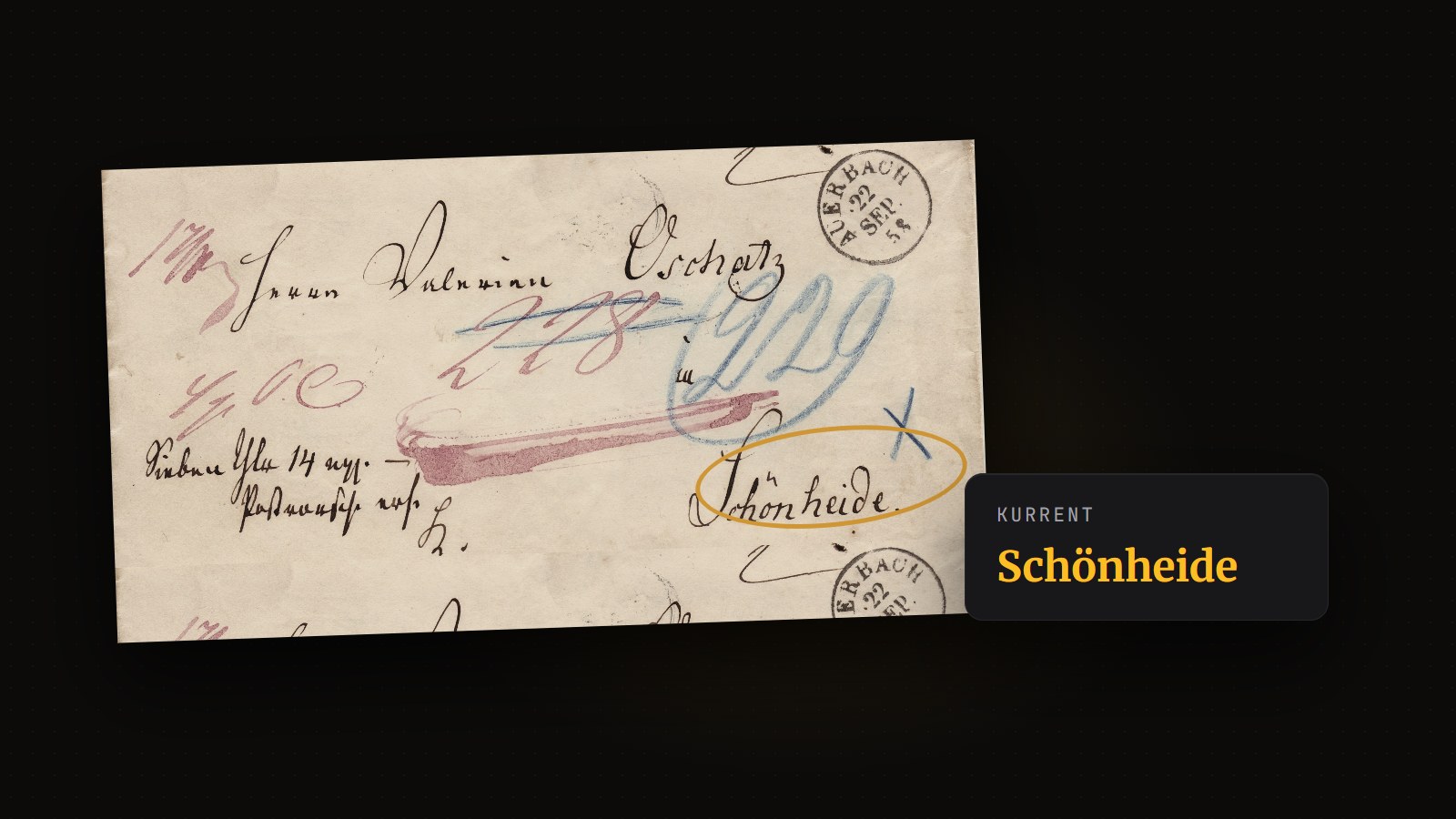
The old German handwriting is a distinct script called Kurrent, which evolved from gothic cursive at the beginning of the 16th century. For roughly four hundred years, Kurrent was how German was written by hand: in church books, civil registers, business ledgers, and personal letters across the German-speaking world.
Kurrent looks alien to a modern reader because its letterforms follow a different logic than the Latin cursive taught today. Letters are narrow, angular, and full of near-identical strokes. An "e" can look like an "n." An "n" can look like a "u." A single word can appear to be a picket fence of vertical marks. It is legible once you know the system.
Sütterlin, and the break in 1941
Early in the 20th century, a graphic artist named Ludwig Sütterlin designed a simplified, rounder version of Kurrent for teaching. This Sütterlin script was adopted in Prussian schools in 1915 and, by 1934, was taught in virtually every German school. For a generation, Sütterlin was German handwriting.
Then it stopped, almost overnight. On January 3, 1941, a decree issued by Martin Bormann on Hitler's behalf abolished Fraktur type in print. A separate circular of 1 September 1941 then ended the teaching of Kurrent and Sütterlin in schools. The stated justification was propaganda (the regime falsely branded the scripts as being of "Jewish origin"); the practical reason was that occupied Europe, from Paris to Warsaw, could not read the jagged German letters. From the 1941/42 school year onward, only the modern "Normalschrift", ordinary Latin cursive, was taught.
The consequence for genealogy is direct. Anyone schooled in Germany after roughly 1941 was never taught to read Kurrent or Sütterlin. That is why a native German speaker today can hold a great-grandparent's birth record and not read it.
Kurrent, Sütterlin, Fraktur - which is which
These three terms get tangled, so it helps to separate them:
- Kurrent is the broad family of old German handwriting used from the 16th century to the mid-20th.
- Sütterlin is a specific early-20th-century teaching form of Kurrent. All Sütterlin is Kurrent; not all Kurrent is Sütterlin. Records from the 1800s are usually in older Kurrent hands, not Sütterlin.
- Fraktur is a printed blackletter typeface, the dense, angular type you see in old German books and newspapers. It is not handwriting. If a page is typeset, it is Fraktur; if it is handwritten, it is Kurrent.
Knowing which you are looking at tells you what to learn. A printed church-record heading is Fraktur; the entries filled in below it are Kurrent.
How to start reading it
You can begin without fluency. You need the alphabet and a few habits.
Start with a Kurrent alphabet chart. Print one and keep it beside the record. Most of the work early on is simple matching: find the strange letter, locate it on the chart. After a few dozen entries, you stop needing the chart for common letters.
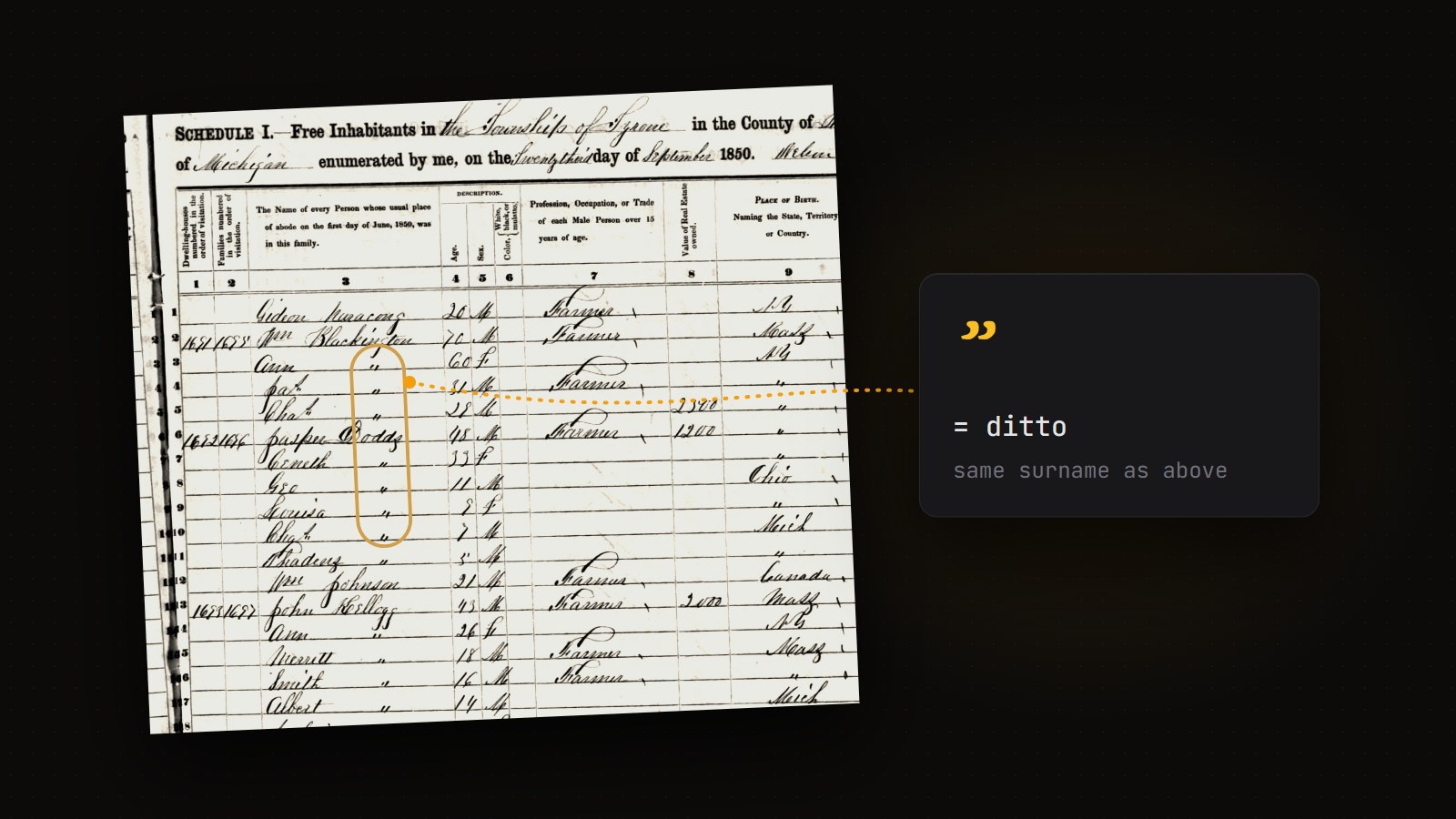
Read the whole page before your entry. A single scribe wrote the page in one consistent hand. After ten or fifteen entries you learn how this particular writer forms their letters, and your target entry becomes far easier to decode. The same habit helps with any dense old hand, including old census records.
Use words you already expect. Church and civil records are formulaic. The same words repeat constantly: geboren (born), getauft (baptised), gestorben (died), Sohn, Tochter, Ehefrau, month names. Learning to recognise this small vocabulary by shape gets you through most of a page.
Watch for Latin. Catholic parish registers in particular often mix Latin terms and dates into an otherwise German entry, which can help, because Latin month and status words are frequently more legible than the German ones.
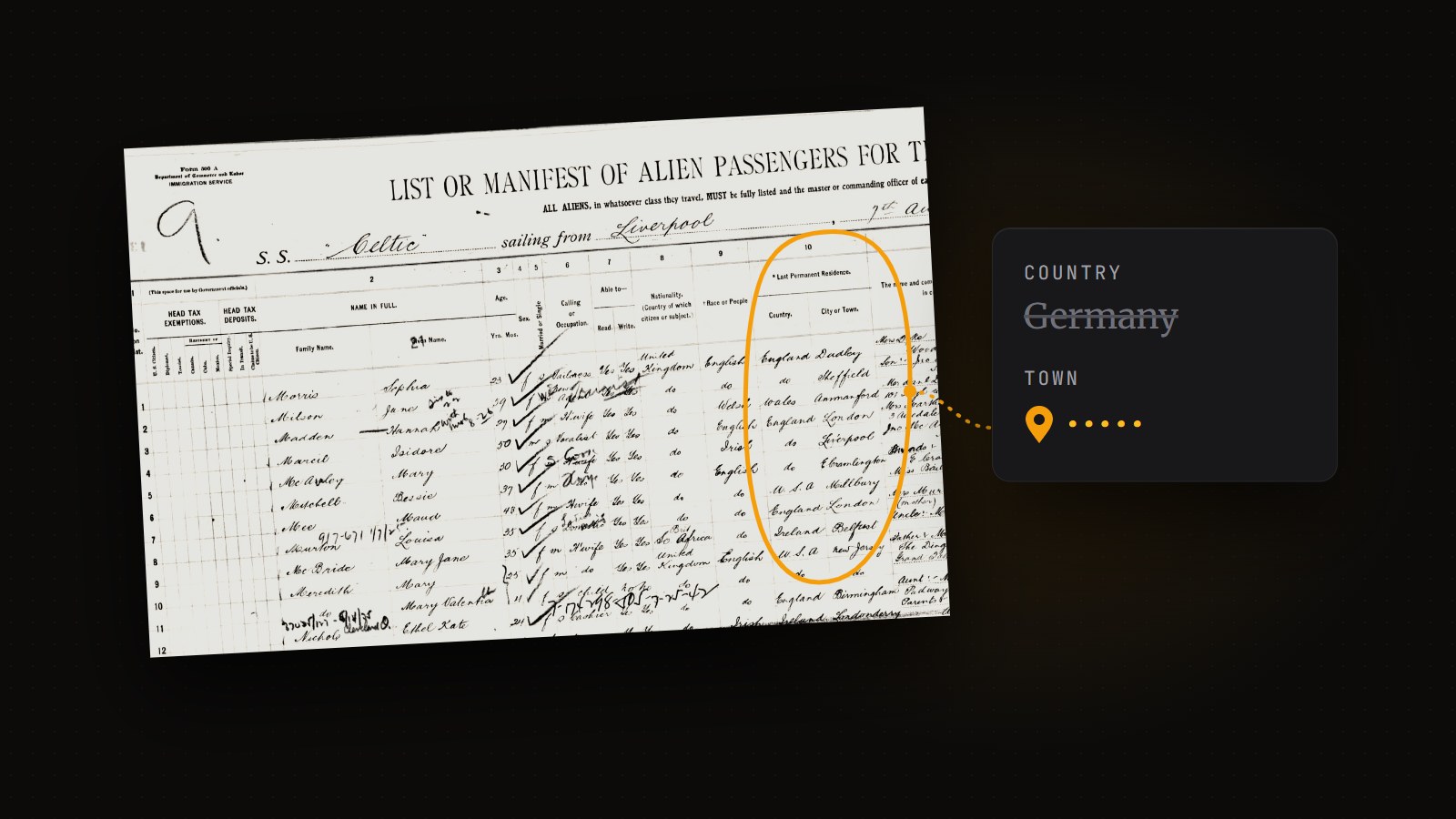
For a single treasured document, learning to read it yourself is rewarding. For a whole box of Kurrent records, it helps to know that AI has largely caught up with these scripts. KleioBase, an AI research companion that turns scattered historical records into one connected family archive, reads Kurrent and Sütterlin and pulls out the names, dates, and places. It clears most of a box quickly and leaves only the hardest hands (faded ink, heavily stylised capitals) for a second look, so your time goes to the research rather than the decoding.
The letters that trip everyone up
A handful of Kurrent letterforms cause most misreadings:
- e and n look nearly identical: both are small pairs of vertical strokes. Context and the writer's habits are the only reliable way to tell them apart.
- u and n are also easily confused. To help, writers often placed a small curved mark (a bow or breve) above the u. If you see that little arc, the letter beneath it is a "u."
- The long s (ſ) looks like an "f" without the full crossbar and appears in the middle of words. "Haus" can look like "Hauf" until you know it.
- Capital letters are the most stylised and variable of all. When a capital defeats you, find the same name or word elsewhere on the page where the letter appears again and compare.
- h, and the tails of letters loop below the line in ways that overlap the row beneath, making dense pages look more tangled than they are.
Where German records live - and what they are written in
Two record types carry most German genealogy, and both are usually in Kurrent:
- Kirchenbücher (church books) are the parish registers of baptisms, marriages, and burials, many stretching back to the 1500s and 1600s. Protestant records are typically in German Kurrent; Catholic records often blend German and Latin.
- Standesamt (civil registration) records begin in 1876 across the German Empire (earlier in parts of Prussia) and record births, marriages, and deaths in a standardised form, still handwritten in Kurrent for their first several decades.
Large collections are increasingly digitised (Archion for Protestant church books, Matricula for Catholic ones, plus FamilySearch and other archives), which means the images are often a search away. The reading is the part that still stops people.
When the handwriting is the wall
If you have found the record and the only thing between you and your family's history is a script no one alive was taught, that is a palaeography problem, not a research dead end. Learning Kurrent is worthwhile, and for a few key documents it is the most rewarding way to do it.
For larger volumes, AI tools such as KleioBase can read Kurrent and Sütterlin records and extract the structured details (names, dates, places), so your time goes to the research rather than to the handwriting. Either way, the record was never lost. It was written in a hand that fell out of the world in 1941.
German family history rewards patience with the script. Once the letters resolve, these registers are extraordinarily rich: generations of a single village, recorded line by line, waiting to be read again.
Follow KleioBase on Google
Add us as a preferred source to see our research guides more often in Google Search and AI results.
Start building your family history
Upload a record and let KleioBase transcribe, translate, and connect it - all in one place, with a research partner that remembers everything you find.
Get started