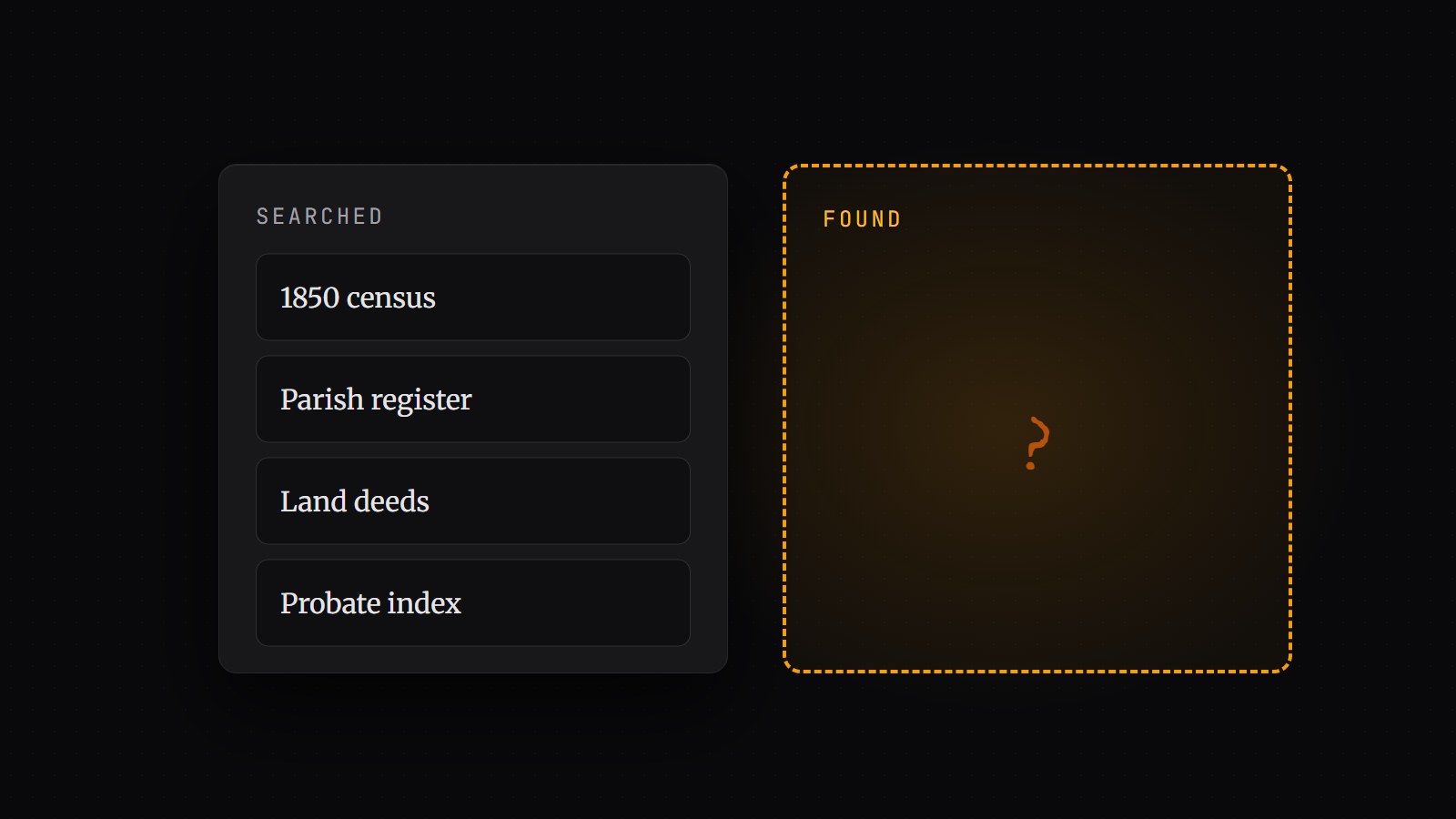
Everyone who does this long enough acquires one. A great-great-grandfather who appears fully formed in an 1878 marriage record and has no past. A woman named in four documents as somebody's wife and never once under her own surname. A family that steps off a ship and out of the historical record at the same moment.
You have searched the name in every index you can reach. You have tried the spellings. You have widened the date range until it is useless. The wall does not move.
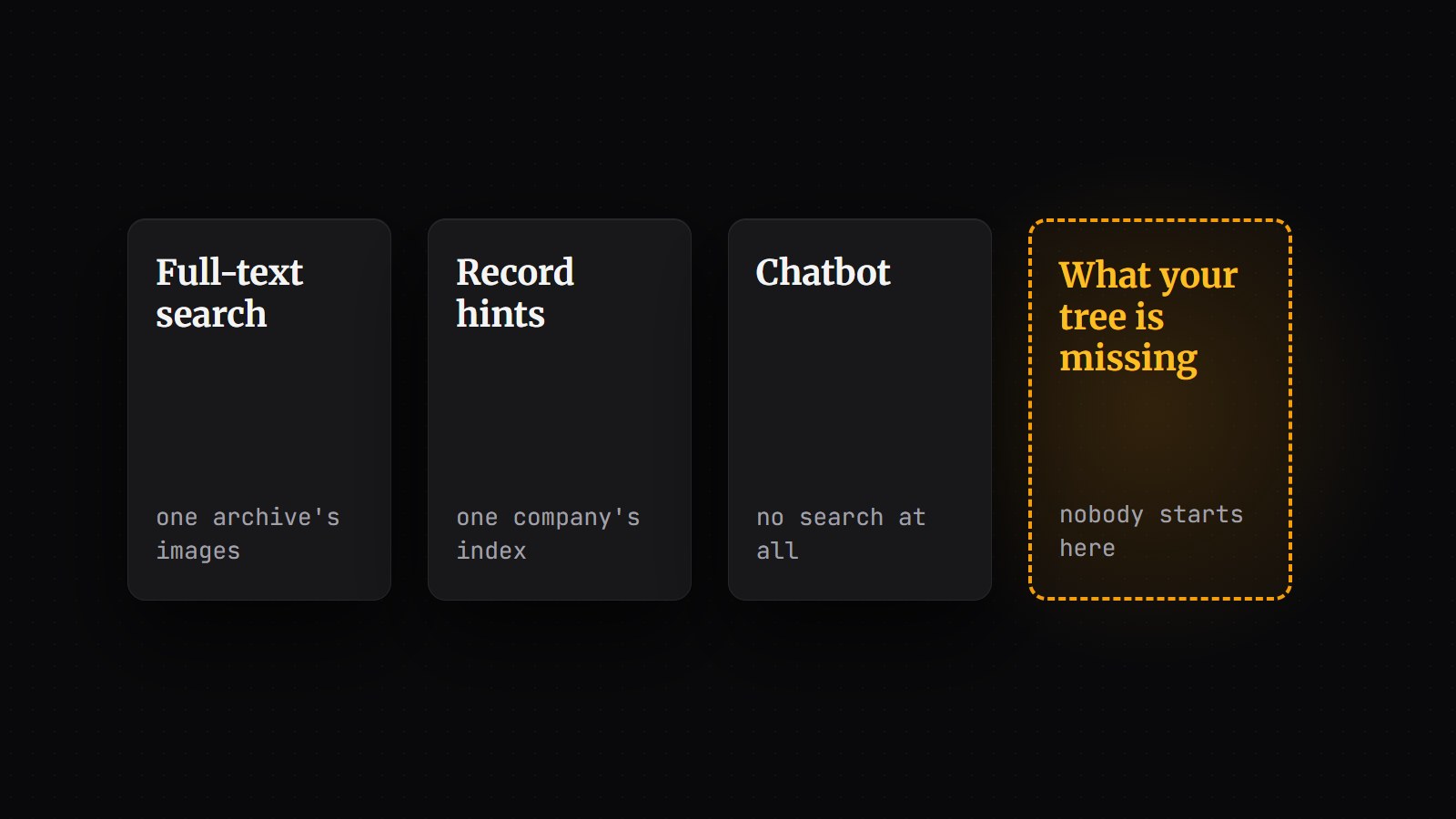
The reason it does not move is usually that you are searching for the wrong person.
What a brick wall actually is
It helps to be precise about which of three problems you have, because only one of them is a wall and the other two are just work.
The record does not exist. The register burned, the volume was never kept, the event happened in a jurisdiction that did not record it. That is a boundary rather than a brick wall, and the correct response is to establish it properly and write it down, which is what negative evidence is for. A boundary you have proved is a research finding. A boundary you have assumed is a guess.
The record exists but you cannot find it under that name. Spelling drift, a clerk's ear, Latinisation, a patronymic, a maiden name you do not know, an index built from a bad transcription. Frustrating, but tractable: you attack it with wildcards, with soundex, by browsing the register page by page instead of trusting the index, and by learning the local naming conventions.
The record exists, it names your ancestor, and it is indexed under somebody else. This is the real wall, and it is the most common of the three.
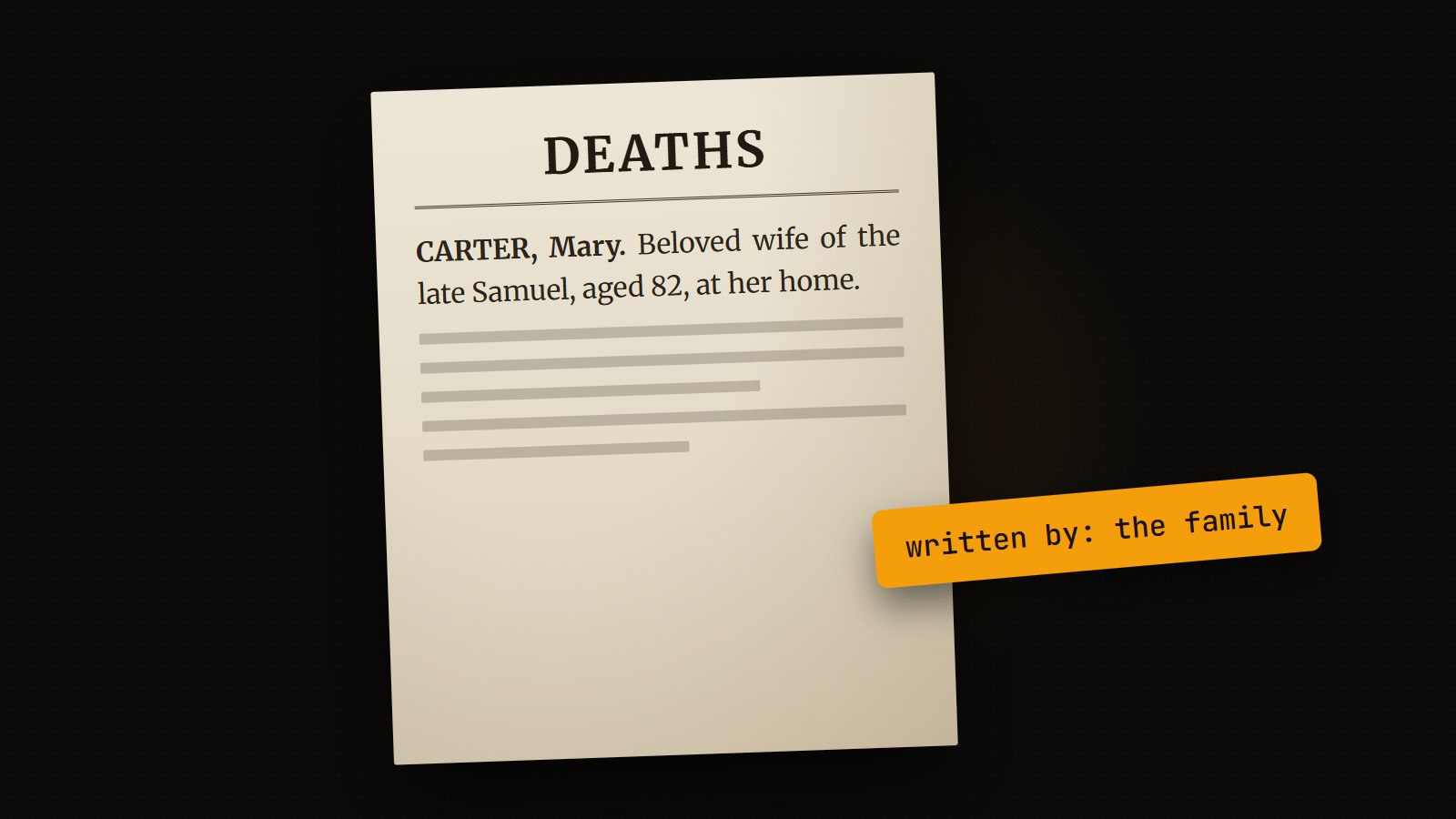
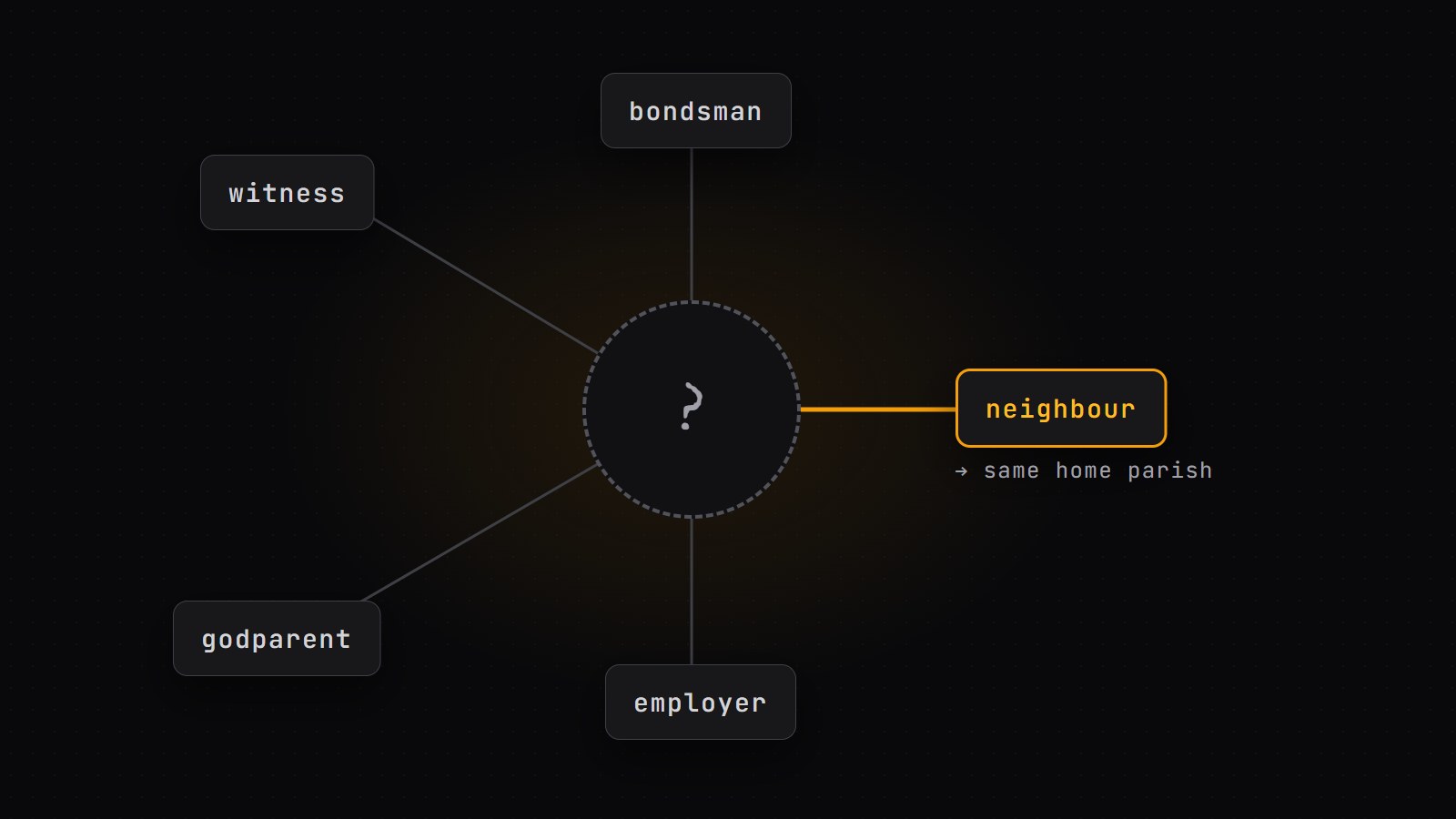
Indexes are built around the principal parties. A marriage is indexed under the bride and groom. A deed is indexed under grantor and grantee. A will is indexed under the testator. Everybody else in the document (the witnesses, the sureties, the godparents, the informant, the neighbours who signed the affidavit) is invisible to search, even though the document names them in full and often states their relationship outright.
Your ancestor is in that record. You cannot find him because the finding aid was never built to find him.
The FAN principle
The technique for getting at those records has a name. The genealogist Elizabeth Shown Mills coined the term FAN club for the cluster of people surrounding an ancestor: Friends (and Family), Associates, and Neighbours. The same idea is older and also goes by cluster research or collateral research. The core claim is straightforward: to establish identity, origin, and parentage, you have to study a person in the context of the people around them rather than in isolation.
Mills teaches it as a set of questions you ask about the cluster. Who are the known members? What did they do together? When did the association occur? Where? And why did these people interact at all?
The last one carries the weight. Nobody witnessed a marriage in 1840 because they happened to be passing. Standing as a godparent, posting a marriage bond, swearing to a neighbour's residence at naturalisation: these were acts of obligation, performed by people who had a reason. The reason is frequently kinship, and where it is not kinship it is usually geography, trade, congregation, or the plain fact of having come from the same village.
That is why the method works: a cluster records the relationships that mattered enough to be written down.
Where the FANs are hiding
Most researchers already own the answer to their brick wall and have discarded it, because they extracted only the people they were looking for from records they had already found. Before you search for anything new, go back through what you have.
Marriage records. Witnesses, and in jurisdictions that used them, the bondsman or surety. A marriage bond in the American South was frequently posted by the bride's father or brother, which makes it one of the most direct routes to a maiden name in existence. The officiant tells you the congregation, which tells you where the rest of the family's records will be.
Baptism and birth records. Godparents, above all. In Catholic practice the sponsors named in a baptismal register are more often than not relatives of the parents (an aunt, an uncle, a grandparent), and where they were not, they were the family's closest social tie. Orthodox practice works differently and is just as useful: godparenthood, kumstvo in the Balkans, deliberately created ritual kinship between families who were not previously related, and among Bulgarians, Serbians and Macedonians that bond was inherited down the generations. Blood relation or alliance, a child's godparents are frequently a better guide to a family's connections than anything the parents' own records say.
Death and burial records. The informant. Whoever reported the death was standing there, usually a spouse or a child, and their name and relationship are stated on the certificate. Note that the informant's reliability is uneven: they knew the deceased well, which is why they could report the death, but they often knew the deceased's own parents only by hearsay.
Census records. The households on the lines above and below. Enumerators walked a route, so adjacency on the page is adjacency on the street. Reading the two pages either side of your family is one of the cheapest research acts available and one of the least performed. See reading old census records for the rest of what a census page will give you.
Land and probate. Grantor and grantee chains, adjoining landowners named in a boundary description, witnesses to a will, executors, bondsmen, and the list of purchasers at an estate sale. Estate sale lists are unusually good: estate sales were most commonly attended by relatives and neighbours of the deceased, so the purchaser list tends to be full of the surviving spouse, adult children, in-laws and collateral kin.
Immigration and naturalisation. The US manifest form introduced by the Act of 3 March 1893 asked whether the passenger was going to join a relative and, if so, that person's name, address, and relationship to the passenger; by 1907 the form ran to 29 columns across two pages. Travelling companions grouped on the same manifest lines are rarely strangers. Naturalisation required witnesses to swear to residence and character, and they were usually men from the same town who had arrived earlier.
Military and pension files. Pension applications generated sworn affidavits from people who could testify to a marriage, a birth, or a period of service. These are among the richest FAN sources in existence, because the entire purpose of the document is to have somebody else describe your ancestor's life in detail.
Newspapers. Obituary survivor lists, and the social columns recording who visited whom. A line reading "visiting her sister, Mrs J. Kowalski of Buffalo" has broken more walls than most database searches.
The two cases where this is not optional
For most research the FAN principle is an accelerant. For two categories of ancestor it is the only method there is.
Women. A woman's maiden name is often recorded nowhere that she is the principal party. It appears in her father's will, her brother's deed, the bond her uncle posted, the baptism where her sister stood as godmother. For recovering a maiden name, cluster research is frequently the entire strategy.
People the records were not written to name. Enslaved ancestors before 1865 appear in the documents of the people who claimed to own them: in probate inventories, in deeds, in estate divisions. Reconstructing those families means researching the enslaving family as thoroughly as your own, tracing where their property went at death, and reading the deeds for land your family bought afterwards, which was frequently bought from the former enslaver. The same structural problem applies to any population that enters the archive only as the object of someone else's record keeping.
A method you can actually run
The concept is easy. Applying it is where most attempts collapse, because the cluster grows faster than your notes do. The sequence below keeps it bounded.
1. Inventory every human name you already have. Include every name in every document in your collection, not only the people you were researching: witnesses, clerks, godparents, neighbours, the doctor, the man who sold the land. Most researchers are startled by how many names they have read past.
2. Count. Sort by how many separate documents each name appears in alongside your family. One appearance is noise. Three appearances across twenty years is a relationship.
3. Weight by the cost of the act. Not all associations are equal. Signing as a witness to a will, posting a marriage bond, standing as godparent, or swearing an affidavit are deliberate acts that carried obligation and sometimes financial risk. Living four doors down is weaker evidence. Being enumerated on the same page is weaker still. Rank the cluster by what the association would have cost the person.
4. Research the top of the cluster as if they were your ancestor. Build out the two or three strongest FANs properly: their parents, their siblings, their migrations. It feels like a detour, but you are looking for the document in their file that names your ancestor.
5. Follow the group, not the person. People migrated in chains. If your family vanishes from a Galician village in 1889, find out where the other families from that village went, and look there. A sibling or a neighbour who moved first is often the reason the rest moved at all, and their arrival records will name the ones who followed.
6. Write down what you searched and found nothing in. Cluster research generates a great many dead ends, and a dead end you cannot remember is a dead end you will walk into again. Record the source, the years covered, and how you searched it.
The part other articles leave out
Cluster research is usually presented as a clean insight. In practice it has three failure modes worth knowing about before you start.
You cannot tell in advance which FAN matters. You will research four people thoroughly and learn nothing from three of them. That is the shape of the method, not a sign you are doing it badly. Budget for it, and stop a line when it stops producing rather than when you have finished it out of tidiness.
Not every repeated name is a relative. Some names recur because the person was a fixture, not a relation. A parish clerk who witnessed four hundred marriages, a village mayor whose name is on every civil act for thirty years, a physician who attended half the births in the district: these people are the loudest signal in your cluster and they mean nothing at all. Before you get excited about a name appearing in six of your documents, check whether it also appears in six documents belonging to families you are certain you are not related to. If it does, it is furniture.
The bookkeeping is the actual bottleneck. This is the honest reason cluster research is recommended far more often than it is practised. Holding thirty people, their appearances, their dates, and their relationships to each other in a spreadsheet (or any of the usual research log tools) is possible but miserable, and the moment it becomes miserable you stop updating it, and the moment you stop updating it the method fails.
Cluster research and DNA
If you have tested, the two methods fit together in one direction: the FAN cluster generates hypotheses, and DNA tests them.
A cluster tells you your ancestor was probably connected to the Wójcik family of a particular parish. That is a theory, not a conclusion, and documents alone may never settle it. But it is a theory precise enough to check, by looking for shared matches who descend from that family. Mills' published work on combining the FAN club with the Genealogical Proof Standard and DNA makes this point: DNA lets you assess, scientifically, conclusions reached through cluster research in cases where the paper trail alone could not carry them.
DNA matches without a cluster are a list of strangers, and a cluster without DNA is an argument that may be right. Together they are a proof.
How KleioBase handles the cluster
The bookkeeping problem is a data structure problem, so we treated it as one.
When KleioBase reads a document, it extracts every named person, with their role, not only the principal parties: witnesses, godparents, officiants, informants and midwives, along with their dates, places, and stated relationships. Those people become real profiles in your knowledge base rather than a line of text buried in a transcription. The full extraction list is in uploading records.
You review that list before anything is committed. Where the AI spots people who look like officials rather than subjects of the record (a clerk, a registrar, a physician), it flags them at the top with a one-click option to leave them all out, so the parish furniture does not become forty profiles.
Once confirmed, the cluster is queryable. Every profile has a Family Connections panel listing spouses, parents, children, siblings, and associates such as witnesses, each one clickable, so you can walk from your ancestor to the man who witnessed his marriage to that man's own records without leaving the page. The People tab carries a connection status filter with an "associates" option, which hands you the entire supporting cast at once. Associates are deliberately kept out of your disconnected-person count, because a godmother who appears in one baptism is a lead rather than a hole in your tree.
And because associates are stored as people rather than as text, matching applies to them. If the same witness appears in three of your documents under two spellings, that surfaces as a possible duplicate instead of staying invisible. Detected findings, including possible connections, are listed on each person in the family tree and open in Insights, on the Researcher plan and above.
None of this does the thinking. Deciding that a recurring witness is your ancestor's brother-in-law is still an argument you have to build and defend, against the standard any evidence layer has to meet. But you cannot build that argument out of names you threw away at the transcription stage, and that is where most cluster research stalls.
Start with what you already have
Before you buy another subscription or order another film, open the records already in your collection and write down every name in them, including all the ones you were not looking for.
The wall you have been pushing against for two years is very often a document you photographed in 2023, filed under a stranger's name, and never read to the bottom.
Follow KleioBase on Google
Add us as a preferred source to see our research guides more often in Google Search and AI results.
Start building your family history
Upload a record and let KleioBase transcribe, translate, and connect it - all in one place, with a research partner that remembers everything you find.
Get started