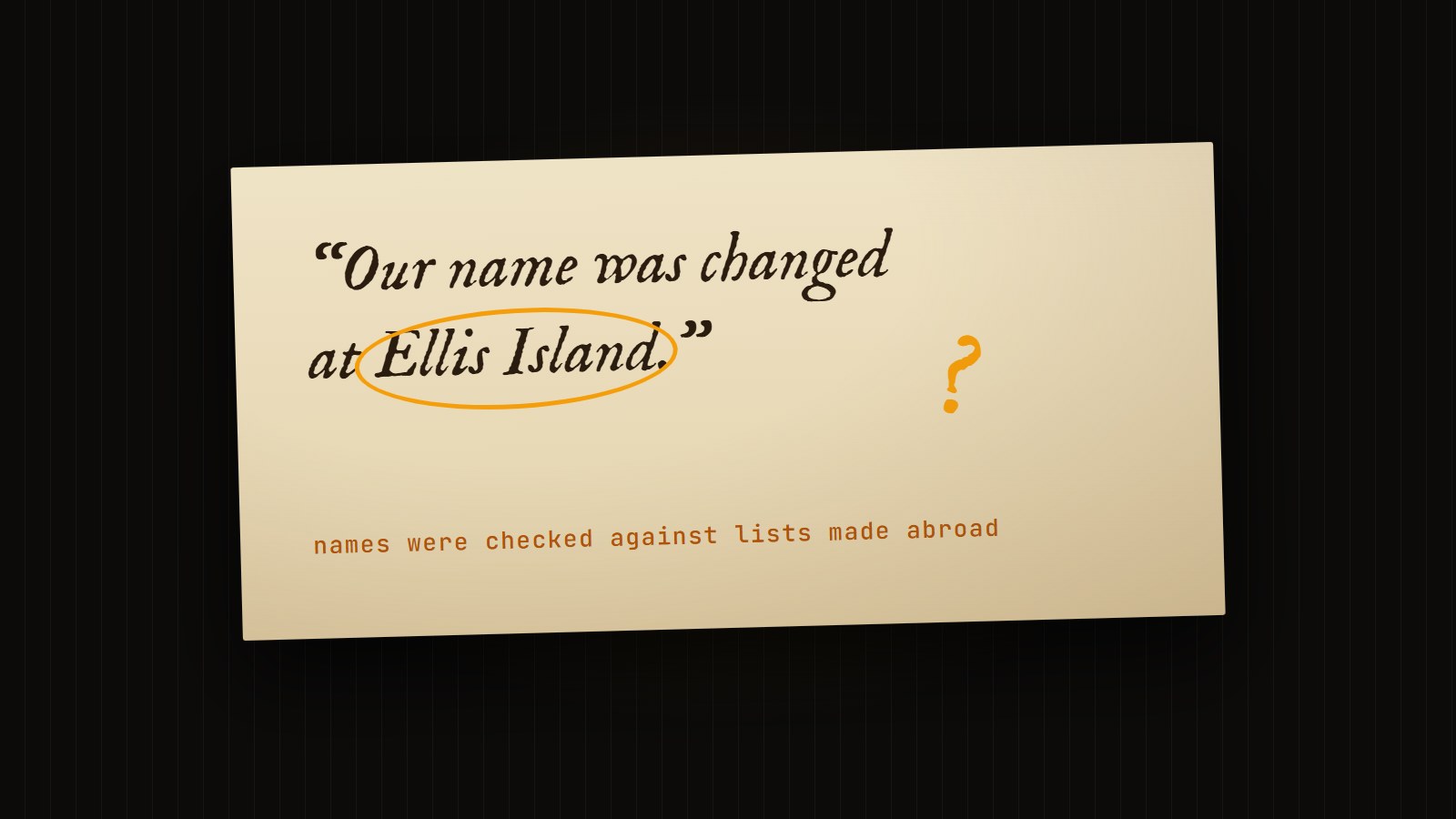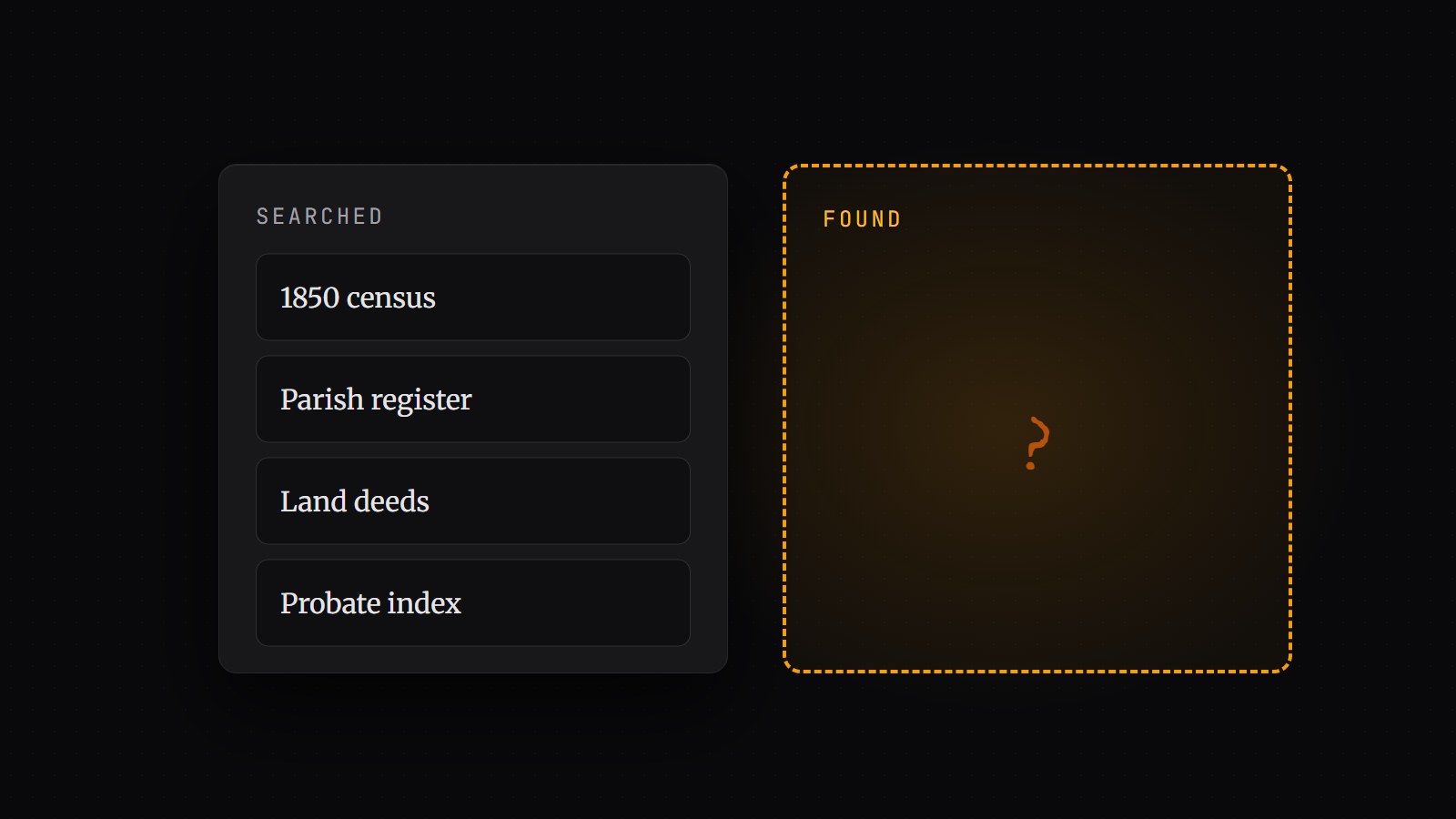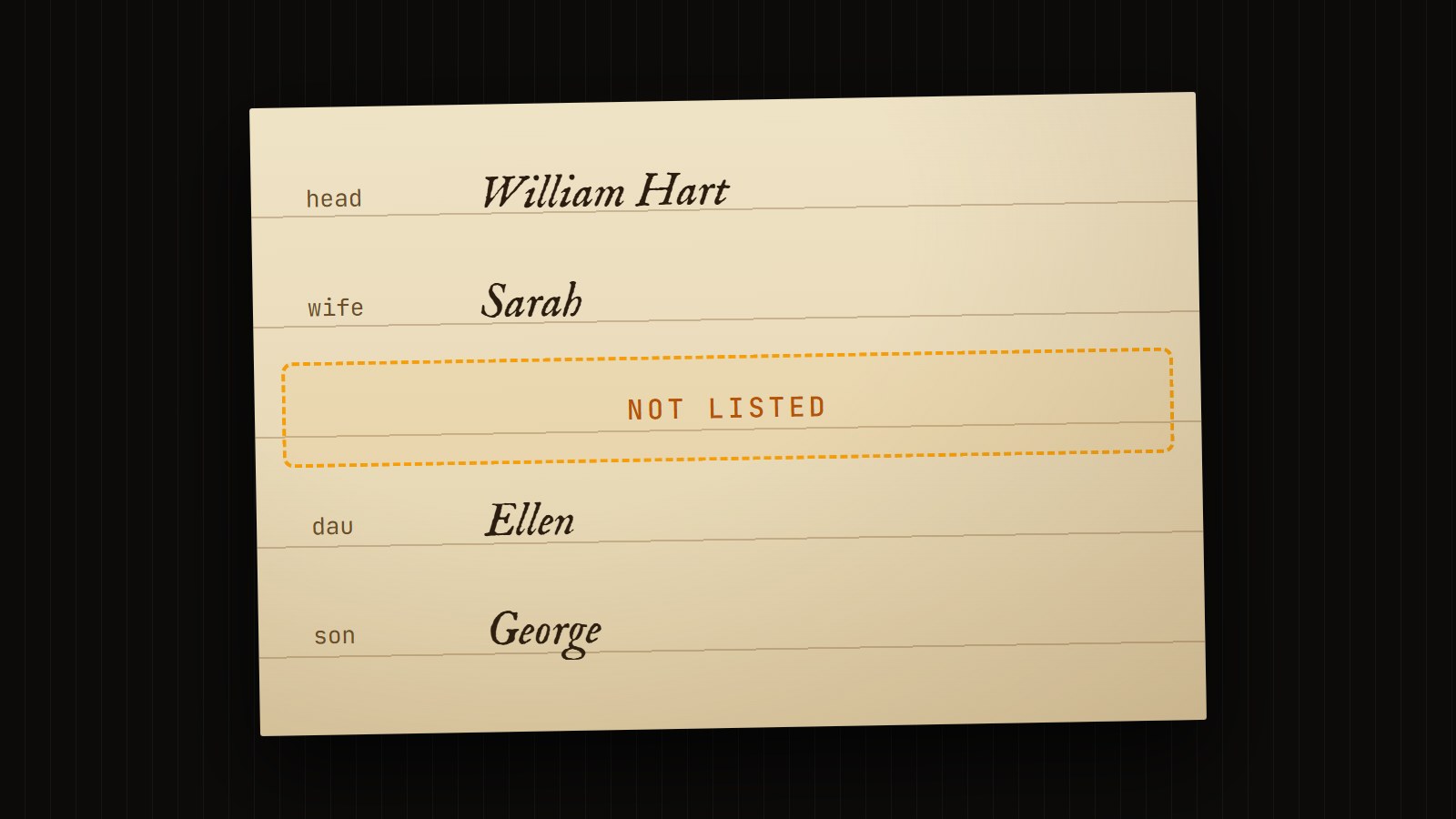
There are two reasons a marriage is missing from your family tree. Either you have not looked for it, or you have looked hard and it is not there.
On the tree itself, both look the same: a blank space. But they are opposite states of knowledge, and confusing them is one of the most common ways genealogical research quietly goes wrong. You re-run searches you already did. You treat a settled question as open. Worse, you treat an open question as settled, because you vaguely remember looking once.
Negative evidence is the discipline that keeps those two blanks apart.
What negative evidence actually is
Negative evidence is a conclusion you draw from the absence of something that should have been there.
The key word is should. It is not simply "I did not find it". It is "I did not find it, in a source where a person like this would normally appear, and that absence tells me something".
An example. A man appears in a county tax list every year from 1840 to 1849, then vanishes from it while the list continues to be kept and continues to name his neighbours. He does not appear in the local burial register either. The absence is an argument: he probably moved away around 1850, and you now have a date range and a reason to search adjacent counties.
That reasoning is the evidence. The blank line in the tax list is just a blank line until you notice that it should not be blank.
The short definition, with answers to the questions people ask most often, is in our glossary entry on what negative evidence is. This article is about putting it to work.
Negative evidence versus a search that found nothing
Genealogical methodology draws a line here that is worth learning, because the two things get called by the same name constantly.
- A negative finding (or negative search result) is what happened when you looked: you searched the register and found no entry. It is a fact about your research process.
- Negative evidence is what you can conclude from that, given what you know about the source: he was not living in this parish, or the family had already converted, or the child did not survive to be enumerated.
Every piece of negative evidence starts as a negative finding. Not every negative finding becomes evidence. If you search a parish register that is missing the years you need, you have a negative finding and nothing more. The absence tells you about the register, not about your ancestor.
Elizabeth Shown Mills, whose Evidence Explained is the standard reference on this, defines negative evidence as an inference drawn from a silence in the records, from the absence of information that should exist under the given circumstances. She adds a condition worth taking seriously: for the inference to be valid, the negative has to be developed into a positive through further research and supporting evidence.
That condition is the discipline. "He is not in the tax list" is a finding. "He is not in the tax list, and he appears in a neighbouring county's list two years later, and his land here was sold in between" is a conclusion.
Both are worth recording, but only the second is an argument.
Why it matters more than it sounds
The first element of the Genealogical Proof Standard is reasonably exhaustive research. Not exhaustive, which is impossible, but reasonably so: enough that a competent researcher would agree you had covered the ground.
You cannot demonstrate that you covered ground without a record of where you looked. A tree full of sourced facts proves what you found. It says nothing at all about the twenty registers you read that gave you nothing, and those twenty registers are often the more impressive half of the work.
This becomes concrete in three places.
Proof arguments. When two records conflict, or when no single record answers a question, you write an argument. "There is no marriage recorded in the parish between 1889 and 1900" is frequently a load-bearing sentence in that argument. It is only credible if you can say which register, which years, and how you searched.
Your future self. Research happens over years. Without a note, you will search the same register again in 2029, find nothing again, and feel exactly as uncertain as you do today.
Anyone reading after you. A cousin, a client, or whoever inherits your files can extend research they can see the boundaries of. They cannot extend a blank space.
What makes a negative search trustworthy
A recorded negative is only as good as the search behind it. Before you treat an absence as meaningful, five questions are worth answering.
Does the source actually cover the years and the place? Registers have gaps. Volumes burn, flood, or get requisitioned. If the 1893 volume is missing, "no entry in 1893" is a statement about the archive, not about the family.
Does the source cover these people? A Catholic parish register will not record a Jewish marriage. A civil register that began in 1874 says nothing about 1870. Denominational, jurisdictional and administrative boundaries determine who was supposed to be written down in the first place. And a source's silence on one fact is not the same as the fact being unknown elsewhere: a Scottish baptism register that names no father for an illegitimate child is not evidence nobody knew who he was, since the parish's kirk session often recorded that question, in a different book kept by a different clerk for a different purpose.
Did you search the pages or an index? This is the big one. An index is a secondary creation with its own transcription errors and omissions, and a name that is absent from an index is frequently present on the page. Page-by-page searching is slower and it is a much stronger negative.
Did you allow for the name changing? Surnames were spelled by ear. Given names were translated at borders. Searching for exactly one spelling and finding nothing is a weak negative; searching for the plausible variants and finding nothing is a strong one.
Would they even have been there? Some events were not registered for everyone. Civil registration coverage varied enormously by country and decade, and some communities recorded life events in their own books that never reached the state.
A negative that survives all five is worth building an argument on. A negative that fails one of them is still worth recording, along with the reason it is weak.
How to record it well
The unit of recording is a short paragraph rather than a line saying "no marriage found", and it contains five things:
- What you looked for. The event, not the person. "A marriage."
- Where you looked. The specific source, named precisely enough that someone else could pull the same volume.
- What span you covered. Years, and where relevant, which parishes or districts.
- How you searched. Indexed or page by page, which spellings, which languages.
- What limited you. Damage, gaps, illegibility, a page you could not access.
Compare the two versions:
Searched for a marriage. Nothing found.
Read the Kalisz Roman Catholic parish marriage register page by page, 1889 to 1900, checking for Kwiatkowski, Kwiatkowska, Kviatkovski and Kwiatowski. No entry. The 1893 volume is water damaged and roughly forty entries are unreadable.
The first is a feeling. The second is a finding, and it also tells your future self exactly one thing to do next: find another source for 1893.
Where to keep it
Historically this lived in a research log, kept separately from the tree, which is why it so often got lost. A log in a spreadsheet is better than nothing and much worse than having the note attached to the person it is about.
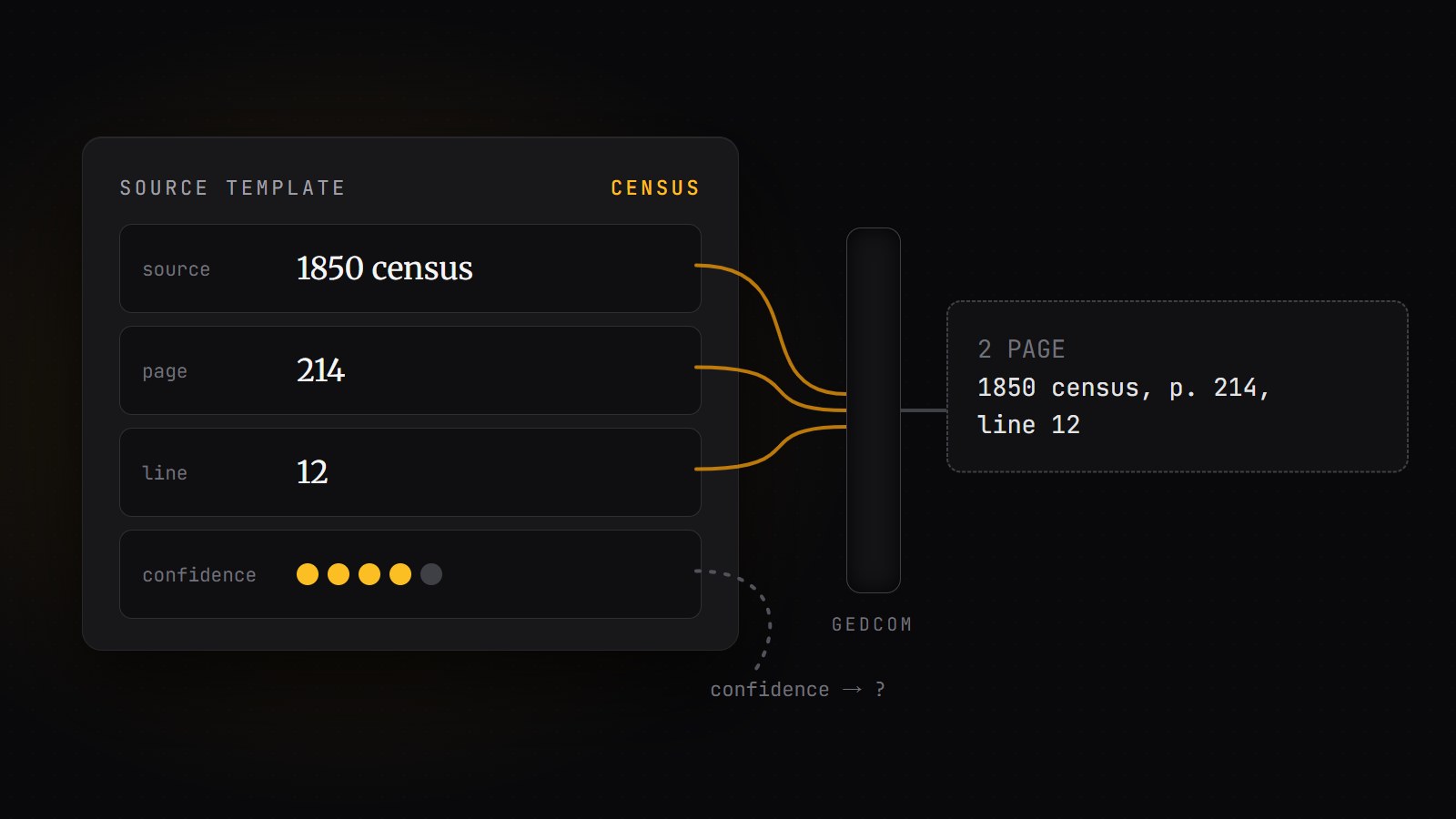
Modern genealogy data formats can carry part of it. GEDCOM 7, the current version of the standard for exchanging family trees, has a structure for the conclusion end of this: a statement that an event did not happen. It looks like this in the file:
1 NO MARR
2 DATE TO 24 MAR 1880
Read aloud: no marriage had occurred as of 24 March 1880. That is the specification's own example, and it is a strong claim. The date bounds it, leaving the date out means the event never happened at all, and the specification says nothing else attached to it may narrow it. A note that reads "searched the parish register" does not turn it into "not found in the parish register".
So NO fits negative evidence you have reasoned your way to, not the raw finding. "Not in this register during these years" is a fact about your search, and GEDCOM 7 has no standard structure for a search result on its own. Keep that distinction in the file as carefully as you keep it in your notes.
A worked example
Say you are looking for the death of a woman last recorded in a 1910 census, aged 22, in a town whose civil death register survives complete from 1874 to 1939.
You read the register for 1910 to 1939. No entry under any spelling. That is your negative finding.
Now the reasoning. The register is complete, it covers her town, it covers everyone regardless of denomination, and you searched the pages rather than the index. If she had died in that town in those years, she would be in it. She is not.
So the negative evidence is: she did not die in this town before 1939. So she left, and a dead end becomes a specific next step: emigration records, marriage records under a new surname, and the towns her siblings moved to.
Notice that the conclusion is narrow. You have not established when she died or where. You have eliminated one place across a defined span, and eliminating places is how you find people.
Recording negative evidence in KleioBase
KleioBase is built around a connected archive of your records rather than a form you type conclusions into, so a search that found nothing belongs in it the same way a record does. It has a dedicated place for that.
Open any person, choose Edit profile, then More details and Negative evidence. Add an entry with the kind of record you looked for, the period your search covered, and notes describing what you searched. The step-by-step guide in our docs covers every field.
Three things happen once you do.
It appears where the gap is. Dated entries plot on the person's timeline under the research overlay, at the start of the period searched, struck through and in a muted tone so a search that found nothing can never be mistaken for something that happened. The gap in your research and the reason it is a gap sit in the same place, instead of the note living in a file you have to remember to open.
It stops the app nagging you. KleioBase suggests records you should probably be able to find for each person. Once you have recorded that there is no marriage record, it stops suggesting you look for one. It keeps suggesting census records though, because not finding someone in 1890 says nothing about 1900.
It leaves with your data. Entries travel in your GEDCOM export and are read back on import. An entry with no period, recording that an event never happened, is written as the standard NO structure above. An entry with a period is a search result, so it goes out as a documented extension rather than as NO, which would overstate it as "did not happen".
You can also leave the period empty, which is how you record that an event never happened at all rather than simply not being recorded. A woman who never married has no marriage record anywhere, and that is a fact about her life rather than a limit on your search.
The habit worth building
The next time a search comes up empty, spend the extra ninety seconds. Write down the source, the span, and how you searched it, while the details are still in your head.
You will not feel the benefit that day. You will feel it in two years, when you open that person and find, instead of a blank space, a note in your own handwriting telling you that the ground has already been covered and pointing at the one place you have not looked yet.
Follow KleioBase on Google
Add us as a preferred source to see our research guides more often in Google Search and AI results.
Start building your family history
Upload a record and let KleioBase transcribe, translate, and connect it - all in one place, with a research partner that remembers everything you find.
Get started