You have spent an evening on one citation. The 1850 census entry for your great-great-grandfather now has its county, its page, its line number, the National Archives microfilm roll and the website where you saw the image, laid out the way the style guides say it should be. Your program built it from a template, and it looks right.
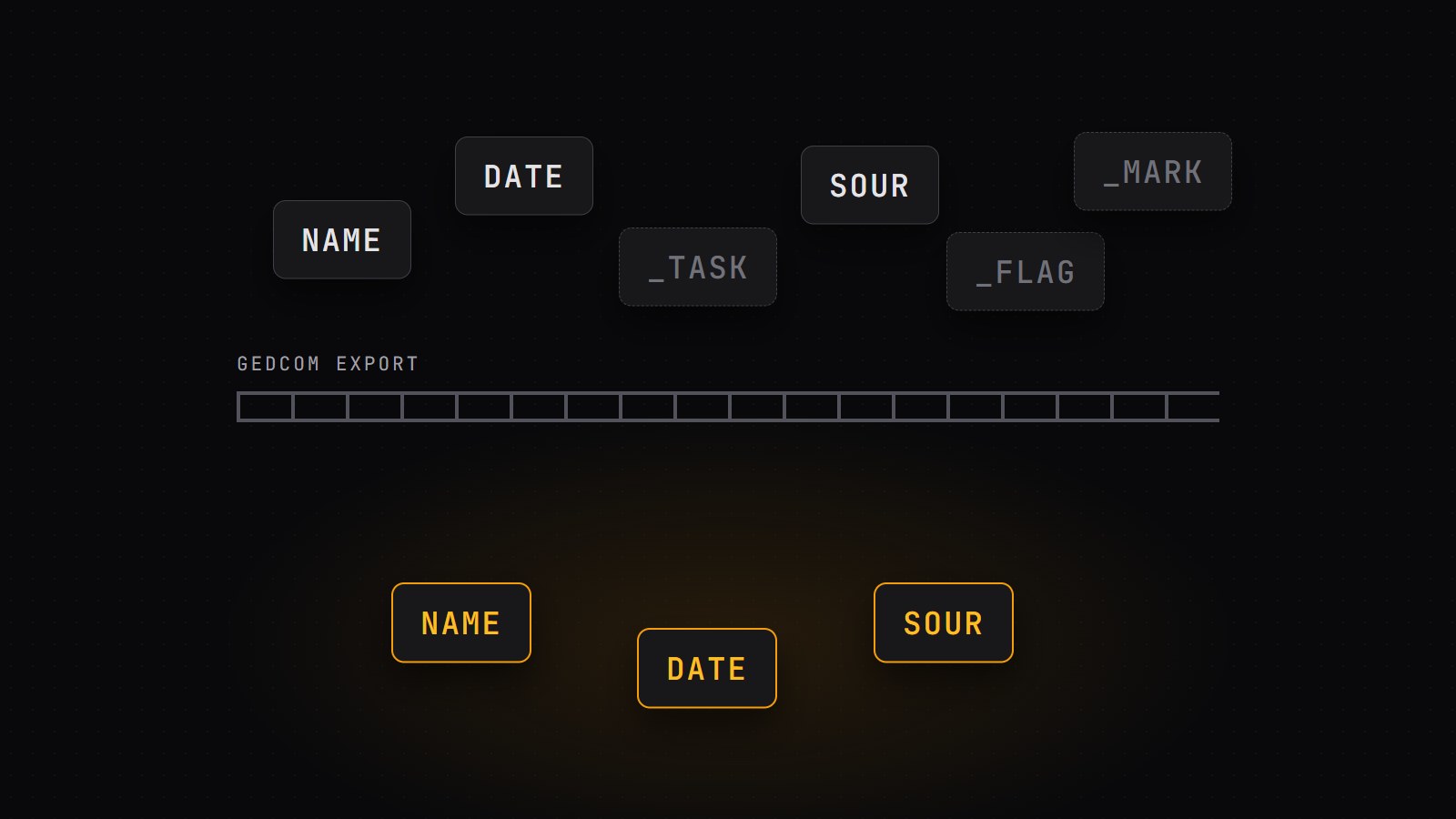
Then, two years later, you move to a different program, or send your tree to a cousin, and the citation arrives as one long string of text in a field called "free-form". Every part of it is still there. The structure that let the program assemble it is gone.
Most comparisons of genealogy software treat citation support as a checkbox. It is better treated as two questions: how the program helps you write a citation, and what is left of that citation when the data leaves the program.
The short answer. RootsMagic, Legacy Family Tree and Family Tree Maker all build citations from templates modelled on Elizabeth Shown Mills's Evidence Explained, but in very different numbers: RootsMagic 12, released on 8 October 2026, cut its list from more than 400 templates to 18, the Family Locket blog's review counted over 1,200 in Legacy, and Family Tree Maker has 170. Gramps uses no templates and instead records a five-level confidence rating on each citation. The templates do not travel. GEDCOM, the file format every one of these programs uses to exchange trees, has no structure for a source template, so a templated citation exported from one program generally arrives in another as free text. If citations matter to you, choose a program whose citations you can live with as plain text, and test an export before you commit years of work to it.
Templates are how three of the four programs build a citation
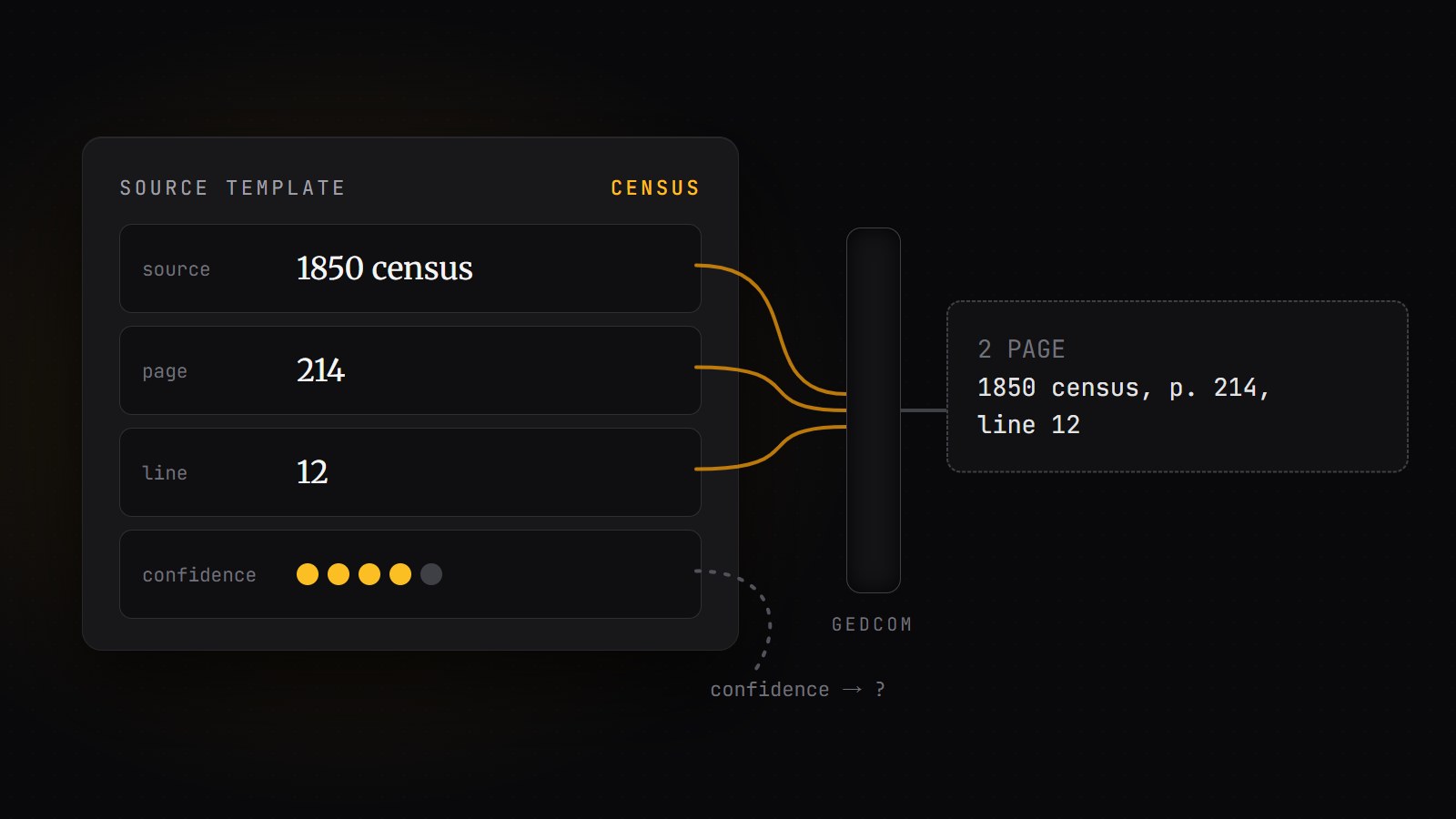
A source template is a form. You tell the program what kind of source you are citing, a census schedule seen as online images, say, or a parish register on microfilm, and it asks for the pieces that kind of citation needs. Then it assembles the footnote, a shorter footnote for later references, and a bibliography entry, in a fixed order with the punctuation done for you.
The models behind most of these templates come from Mills's Evidence Explained, the guide all three template programs name, and RootsMagic's own help pages list other guides too. The programs differ mostly in how many forms they offer and how strictly they follow the book.
| Program | How citations are built | What the vendor or a tester says |
|---|---|---|
| RootsMagic 12 | 18 templates based on Evidence Explained (4th edition), plus free-form | RootsMagic: the 18 replace the old list of more than 400, and templates already in use keep working |
| Legacy Family Tree | SourceWriter, a template-driven system | Legacy's help: built for "the thousands of formats" sources come in. Family Locket: over 1,200 templates |
| Family Tree Maker | 170 templates based on the QuickCheck models in Evidence Explained | Family Locket: its 1850-1870 census template did not match the book's model |
| Gramps | No templates. Sources and citations are separate records, each citation with a confidence level | Gramps source code: five levels, from Very Low to Very High, defaulting to Normal |
Template counts are as each vendor or tester reported them, and they change between versions. RootsMagic's fell from more than 400 to 18 in a single release.
RootsMagic just cut its templates from 400 to 18
For years RootsMagic's selling point on citations was breadth. Its version 11 help pages describe "almost 400 templates designed from models published in style guides by Elizabeth Shown Mills and Richard S. Lackey", with several templates for the same type of source depending on who created the record, what format you saw it in, and which element should lead the footnote.
RootsMagic 12 reversed that. Its release notes say 18 templates based on the fourth edition of Evidence Explained now replace the old list of more than 400, and that templates you have already used keep working as your own. The citation editor is reorganised into four tabs, Citation, Source Text, Quality and Links, and free-form sources get direct fields for the footnote, short footnote, bibliography and page. A converter can turn a free-form source and all its citations into a templated one, or turn a templated source back into free-form.
What that means if you already use it. Nothing breaks: your existing templated sources keep their templates. What changes is the choice you face for the next source. Fewer templates means less hunting through a list, and more sources that do not fit any of the 18 exactly.
Legacy offers the most templates, and Family Tree Maker the fewest
Legacy Family Tree calls its system SourceWriter. Legacy's help file describes it as a template-driven system that walks you to the right input screen, so that you enter every piece needed to cite a source in "the thousands of formats that exist for them". Each template also has an Overrides tab for the cases where the assembled citation is not what you want. The Family Locket blog, reviewing automated citation builders, counted over 1,200 Evidence Explained templates in SourceWriter, available in the free Standard edition, and reported that its test citation for an 1850 census came out the way the book's model says it should.
Family Tree Maker has 170 templates, a figure given both in Family Locket's review and in a June 2022 handout from the Genealogical Forum of Oregon's Family Tree Maker special interest group, which says they are based on Evidence Explained. Family Locket's reviewer was less happy with them than with Legacy's: the 1850-1870 census citation repeated some elements unnecessarily and had punctuation that did not match the model. On the Evidence Explained forum, one Family Tree Maker user explained why they had stopped using the templates altogether: a template applies to the whole source title, so every citation of that source carried the access date they had entered once.
That forum post is one user's experience, not a review, but it points at a design choice worth checking in any program. Where does the program draw the line between the source (the 1850 census of one county) and the citation (one page, one household, the day you looked)? Get that line wrong and you end up either with dozens of near-identical sources or with details that should differ being forced to match.
Gramps records how sure you are instead
Gramps, the free open-source program, takes a different approach. It has no citation templates. A source is one record, the 1911 census of one country, say, and each citation is a separate record pointing at it, holding the page and date for one fact. Each citation also carries a confidence level. The Gramps source code defines five: Very Low, Low, Normal, High and Very High, with Normal as the default.
That rating is the part of a citation most programs leave out, and it is the part that turns a list of references into an argument. A baptism entered by the priest within days of the birth and a birth year worked back from an age at death are both citations. They do not deserve the same weight, and the confidence field is where you say so.
GEDCOM carries a citation, but not its template
Every program above exports and imports GEDCOM, the exchange format for family trees. The current specification, FamilySearch GEDCOM 7, defines a citation as a pointer to a source record plus a handful of details: where in the source the material is (PAGE), the date and text of the relevant entry, the event the source records and the person's role in it, attached media, notes, and a certainty assessment called QUAY.
There is no field for a template. Searching the version 7.0.18 specification for the word finds it only in the description of the file's own grammar. So a citation leaves a program as its assembled text, with the template's separate fields flattened.
Randy Seaver tested this on his Genea-Musings blog in February 2011, with the programs of the day. Sources he had built from templates in Family Tree Maker 2011, Legacy 7 and RootsMagic 4 all arrived in the other programs as free-form sources, and he found that some programs did not even put the text into the right free-form field. The one exception was a round trip: RootsMagic 4 kept its own templates when it re-imported its own GEDCOM file.
Nobody has published a comparable test of the current versions. We searched for one and found Seaver's 2011 posts, a vendor-community thread from October 2025 about template formatting lost on export, and a GitHub proposal for a GEDCOM extension to carry templates, but no systematic test of the current versions of these four programs against each other. The specification has not added a template structure since, so there is no reason to expect a different result, though we have not run the test ourselves. Our step-by-step check of which parts of your family tree survive a GEDCOM export is the way to find out for your own program.
The confidence rating loses meaning on the way out
QUAY is the only place GEDCOM has to say how good a citation is, and it is a small place. The specification gives it four values:
QUAY | Meaning in the GEDCOM 7 specification |
|---|---|
| 0 | Unreliable evidence or estimated data |
| 1 | Questionable reliability of evidence (interviews, census, oral genealogies, or potential for bias, such as an autobiography) |
| 2 | Secondary evidence, data officially recorded sometime after the event |
| 3 | Direct and primary evidence used, or by dominance of the evidence |
It adds that although the values look like integers, they have no numeric meaning, and its authors say plainly that the structures for representing the strength of and confidence in claims "are known to be inadequate and are likely to change in a future version".
Now put Gramps's five levels through that. Its GEDCOM exporter writes Very High as 3, High as 2, Low as 1 and Very Low as 0, and writes nothing at all for a citation left at Normal. Read against the table, a citation you marked High now says, to any program that reads QUAY the way the specification defines it, that the evidence is secondary and was recorded some time after the event. That may be true of your source. It is not what you said.
Any program with its own rating scale has this problem. Five levels of confidence do not fit into four categories of evidence type, so the reasoning has to live somewhere else. If the reason you trust one source over another matters, write it in a note attached to the citation, where it travels as text, rather than relying on a rating that will be translated on export. Our piece on negative evidence makes the same argument for searches that found nothing: write the reasoning down in words, because a flag does not carry it.
What to check before you choose
The ranking below is ours, because no one publishes one, and you should treat it as our judgement.
If you write reports or a book, the template systems earn their keep: Legacy's for range, RootsMagic's for a shorter list you can learn. Both produce footnotes and bibliographies for you.
If you share your tree or expect to change software, weigh the templates less, because they stay behind. Use the free-form fields well, and make sure the page, the date you viewed it, and the repository are in the citation text itself.
If you care most about weighing evidence, Gramps's confidence field and its source and citation split are closer to how an argument is built, as long as you write your reasons into notes.
Whatever you use, test the round trip. Take your most heavily cited person, a woman with a baptism from an English parish register, an 1880 United States census line and a Mexican civil marriage, for instance, export her, import the file into a second program, and compare every citation field by field. That one test answers more than any feature list, including ours in the wider comparison of genealogy software.
What KleioBase does with sources, and what it does not
We are a tool in this space, so read this as disclosure.
KleioBase is an AI research companion that turns scattered historical records into one connected family archive. It does not build citations from templates. It starts from the other end: the source itself. Each record you upload keeps its scan, its transcription and translation, and the people, dates and places extracted from it, and stays a fixed snapshot of what that document said, while each person's profile holds your conclusion. Facts extracted from a record stay linked to it, and when you ask the Research Companion about a person, the records it relies on appear as chips you can click to see the page.
When you export a GEDCOM file, each record becomes a GEDCOM source with its title, its transcription as a note and, if you choose, its image, and each person cites the records they appear in, with the event and their role in it where KleioBase knows them. That is the approach this article recommends for portable citations: the evidence travels as text and images rather than as template fields. Our guide to moving a tree with a GEDCOM file covers the mechanics.
There are three honest limits.
It does not format citations. There is no footnote, short footnote or bibliography in Evidence Explained style. If you are writing for publication, a template program will do that work and KleioBase will not.
It does not import your existing citations. A GEDCOM import brings in people, families and their facts, but deliberately skips the file's source records and the citation links to them. If your tree's value is in its citations, keep the program they live in, and use KleioBase for the documents themselves.
It does not export a page reference or a confidence rating. Exported citations point at the whole record. If one record holds many entries, the transcription in the note is what tells the next program which line mattered.
Where to start with the citations you already have
Pick the person in your tree with the most sources and print or save their citation list as your current program shows it.
Export that person, or a small branch around them, to GEDCOM, and open the file in a text editor. Find their SOUR lines and read what left the program: the page, the date, any QUAY, any notes.
Then import the file into a second program, free ones are fine for this, and compare. Anything that was a template field and is now a block of text, anything that was a rating and is now missing or renamed, is what you would lose if you moved.
A citation exists so that someone else can find the exact page you looked at, decades later, without asking you. Templates are one way to get there. The test of a citation is whether that stranger can still find the page after your software is gone.
Follow KleioBase on Google
Add us as a preferred source to see our research guides more often in Google Search and AI results.
Start building your family history
Upload a record and let KleioBase transcribe, translate, and connect it - all in one place, with a research partner that remembers everything you find.
Get started