If you know your family came from Poland (a town name on a manifest, a village your grandmother mentioned once, a border region that changed countries three times), there is a good chance the records of their births, marriages, and deaths are already scanned and online, free, with no subscription, account or request form.
The Polish State Archives run a portal called Szukaj w Archiwach ("Search in the Archives"), which publishes over 55 million scans of archival material. Parish and civil registers are among the best-covered collections in it, and they cover everyone: Roman Catholic, Greek Catholic, Orthodox, Lutheran, and Jewish.
The difficulty is that these collections are not searchable by name. You cannot type in your great-great-grandmother and get a hit. What you get is a collection, a list of years, and several hundred scans per year of 19th-century handwriting in no order that helps you.
Most people respond by opening scan 1 and starting to scroll. There is a much better way, and it comes from the way the registers were built in the first place: most annual volumes were closed with an index. Read the index first and the archive stops being a haystack.
The method in four steps
- Find the archival collection for your town and open the year you want.
- Find the index pages inside that volume - usually one to three per record type.
- Have the index read for you, and pull out every surname you care about along with its record number.
- Go straight to those numbered records, download only those scans, and process them properly.
The rest of this guide covers each step, plus the background you need to know which of them apply to your particular corner of Poland.
What is actually in Szukaj w Archiwach
Worth being clear about the scope, because it is wider than most people assume.
- Geography. All of present-day Poland, plus a great deal of material for places now in Ukraine, Belarus, and Lithuania, because the archives inherited the records of towns that were Polish when the records were written.
- Denominations. Roman Catholic parish registers, Greek Catholic (Uniate), Orthodox, Evangelical Lutheran, and Jewish civil registers, each as its own collection with its own catalogue entry.
- Record types beyond vital records. Books of permanent residents (księgi ludności stałej), notarial records, land and mortgage files, school and military records, censuses. These are less digitised and harder to use, but they exist and they answer questions vital records cannot.
- What it is not. It is not a name index. It is a catalogue of collections with images attached. Everything below is about bridging that gap.
First: which partition was your town in?
This one question determines the language, the format, and even the calendar of the records you are about to read. Poland did not exist as a state between 1795 and 1918, and the three partitioning powers ran completely different registration systems.
| Partition | Roughly | Registration | Language of records |
|---|---|---|---|
| Russian (Congress Poland) | Central and eastern Poland: Warsaw, Łódź, Lublin, Kielce, Podlasie | Civil registration from 1808, denominational registers from 1826 | Polish to 1867, Russian 1868-1918, Polish after |
| Prussian | West and north: Poznań, Pomerania, Silesia | Church books, then state Standesamt offices from October 1, 1874 | German (Latin in Catholic books), Polish after 1918-1920 |
| Austrian (Galicia) | South and southeast: Kraków, Rzeszów, Przemyśl | Denominational registers kept by clergy | Mostly Latin, some German and Polish |
If you are not sure which partition your town fell in, look up its location around 1900 rather than today. Borders moved; villages did not.
The rest of this article covers the Russian partition, which is the largest case, the best-covered on Szukaj w Archiwach, and the one the index-first method suits best. The other two work differently enough to need their own treatment:
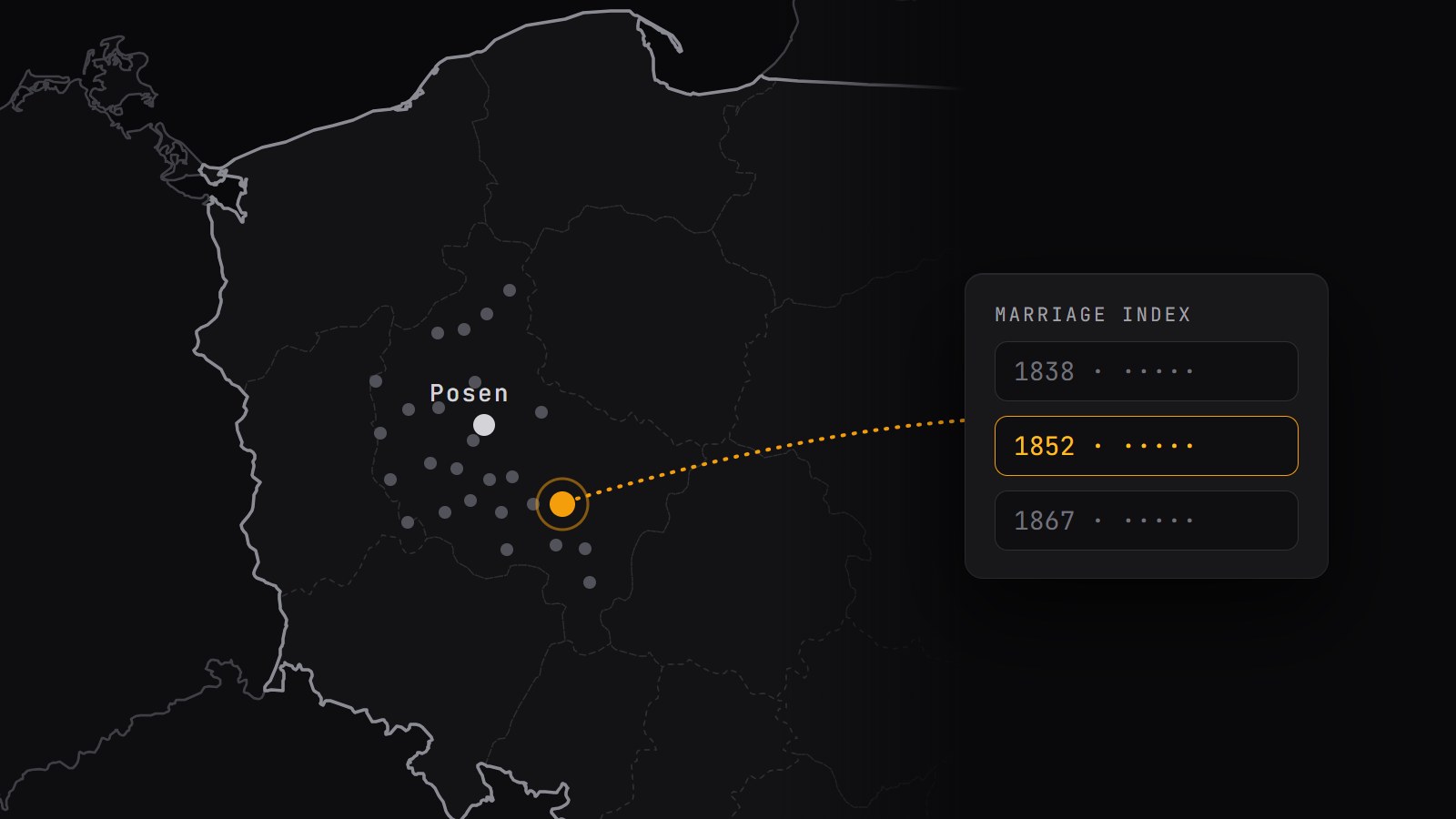
- Prussian partition - church books until 1874, then state Standesamt registers in German, plus the Poznań Project, which indexes every named person in nearly two million marriage records. See Prussian partition records.
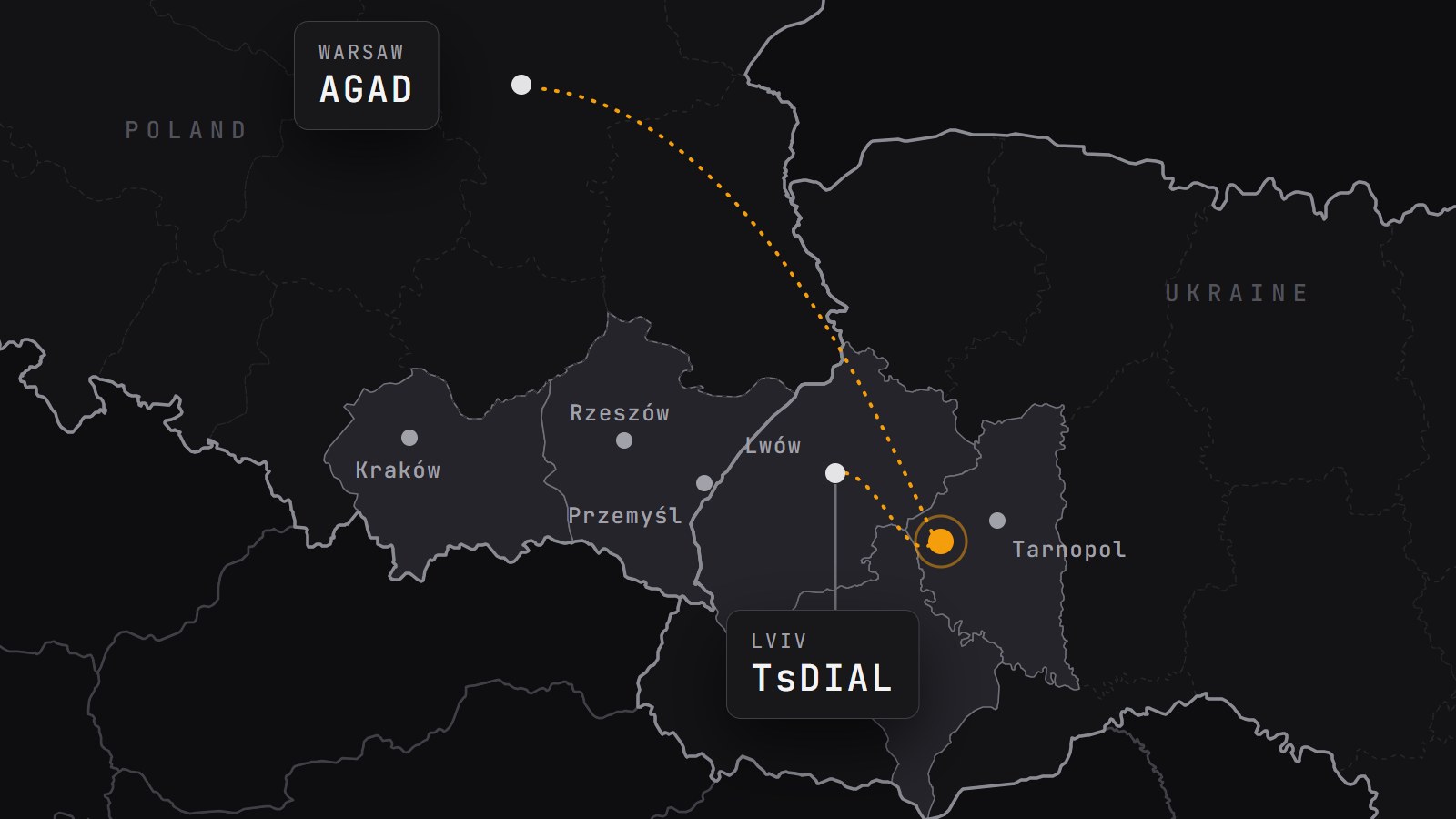
- Austrian partition (Galicia) - columnar Latin registers kept by Greek Catholic, Roman Catholic and Jewish communities alike, with the records split between Polish and Ukrainian archives, so Szukaj w Archiwach is only part of the answer. See Austrian Galicia records.
How Congress Poland registration worked
This is the largest and best-covered case, so it is worth understanding properly.
Civil registration began under Napoleonic law in 1808-1810, and in those first years everyone in a town was registered by the local Roman Catholic parish priest, who acted as the civil registrar regardless of the faith of the person in front of him. Jewish, Lutheran, and Orthodox births and deaths from 1808 to 1825 are mixed into the Catholic parish books. If you are looking for a non-Catholic family in that window and finding nothing, that is why: you are looking in the wrong collection.
That changed on January 1, 1826, when the Civil Code of the Kingdom of Poland took effect and created separate registers for each denomination. Catholic parishes continued as before. Lutheran and Orthodox parishes got their own. And for the Jewish population, towns got a secular registration district called an okręg bóżniczy (synagogue district), where the registrar was not a clergyman at all but a municipal official, usually the mayor (burmistrz), with a rabbi required to attend when the act was drawn up.
Originals, duplicates, and why the index exists
The whole method rests on the fact that each act was written twice.
The unikat (original book) stayed with the parish or office and was filled one record type at a time, running for several years until the volume was full. The duplikat or wtóropis was closed at the end of every calendar year, and when it was closed, an index was compiled, and the whole volume was sent along with its supplements to the local court of the peace.
The annual duplicate volumes are the ones most commonly digitised, and each one is a self-contained year of births, marriages, and deaths with a finding aid built in by the clerk who closed it in, say, January 1841.
The language changes in 1868
Records were kept in Polish from 1808 through 1867. From 1868, under Russification following the January Uprising, they were written in Russian Cyrillic and dated by the Julian calendar then used in the Russian Empire, about 12 days behind the Gregorian calendar in the 19th century, 13 days from 1900. Many acts carry both dates. Polish returned after the First World War.
The wording barely changed. A Russian-language act from 1885 says the same things in the same order as a Polish one from 1845. If you can follow one, the other is mostly an alphabet problem. (More in our guides to Polish records and Russian and Cyrillic records.)
What will not be there
Polish privacy rules restrict birth records for 100 years and marriage and death records for 80. Volumes stay with the local registry office until every act inside is out of restriction, which is why online coverage thins sharply in the 20th century. Ordinary archival gaps exist too. A single missing year in the middle of an otherwise complete run is common, and registers were sometimes destroyed outright in fighting or during the uprisings. In the Biała collection, for instance, the duplicate series runs 1826-1862 and then 1864-1914: 1863, the year the January Uprising began, is absent. A gap is not evidence that your family was unregistered.
A worked example
Here is a real collection, which the rest of this guide will refer back to.
The Jewish registers of Biała Podlaska, in the Lublin region, survive as collection 35/1612/0, Akta stanu cywilnego Okręgu Bożniczego w Białej, held by the State Archives in Lublin. It runs from 1826 to 1933, spans 112 archival units, and more than 11,000 scans of it are published online. The district covered not only the town but surrounding villages (Cicibór, Czosnówka, Grabanów, Ortel Książęcy, Rakowiska, Sidorki, Sitnik, Sławacinek, Styrzyniec, Terebela and others), so a family that never lived in the town itself still appears in the town's books. That last point is general: registration districts and parishes both drew from a catchment of villages, and finding the right catchment is often the whole battle.
The Roman Catholic registers of the same town sit in a separate collection, catalogued the same way, structured the same way, and worked the same way.
Step 1: Find your town's collection
Go to szukajwarchiwach.gov.pl. There is an English toggle in the top right. You do not need an account to browse or view scans.
Three things to know before you search:
Search by place, not by person. The main search box looks like a person search, but vital-record collections are catalogued at the level of the institution that created them, so what you are looking for is a collection.
Use the historical town name. Records use the name the town had then. Biała Podlaska appears in the archives as Biała: the collection is titled w Białej, not w Białej Podlaskiej. Searching the modern name can return nothing while the collection sits there under its old one. A period gazetteer will tell you what your town was called, and Polish diacritics are optional in the search box.
Search the record-creator phrase. Collections are named after the office that made the records, and the pattern is predictable:
- Akta stanu cywilnego Parafii Rzymskokatolickiej w [town] - Roman Catholic
- Akta stanu cywilnego Okręgu Bożniczego w [town] - Jewish
- Akta stanu cywilnego Parafii Ewangelicko-Augsburskiej w [town] - Lutheran
- Akta stanu cywilnego Parafii Prawosławnej w [town] - Orthodox
- Urząd Stanu Cywilnego [town] - 20th-century civil registry office
Searching the relevant phrase plus your town name is usually the fastest way in.
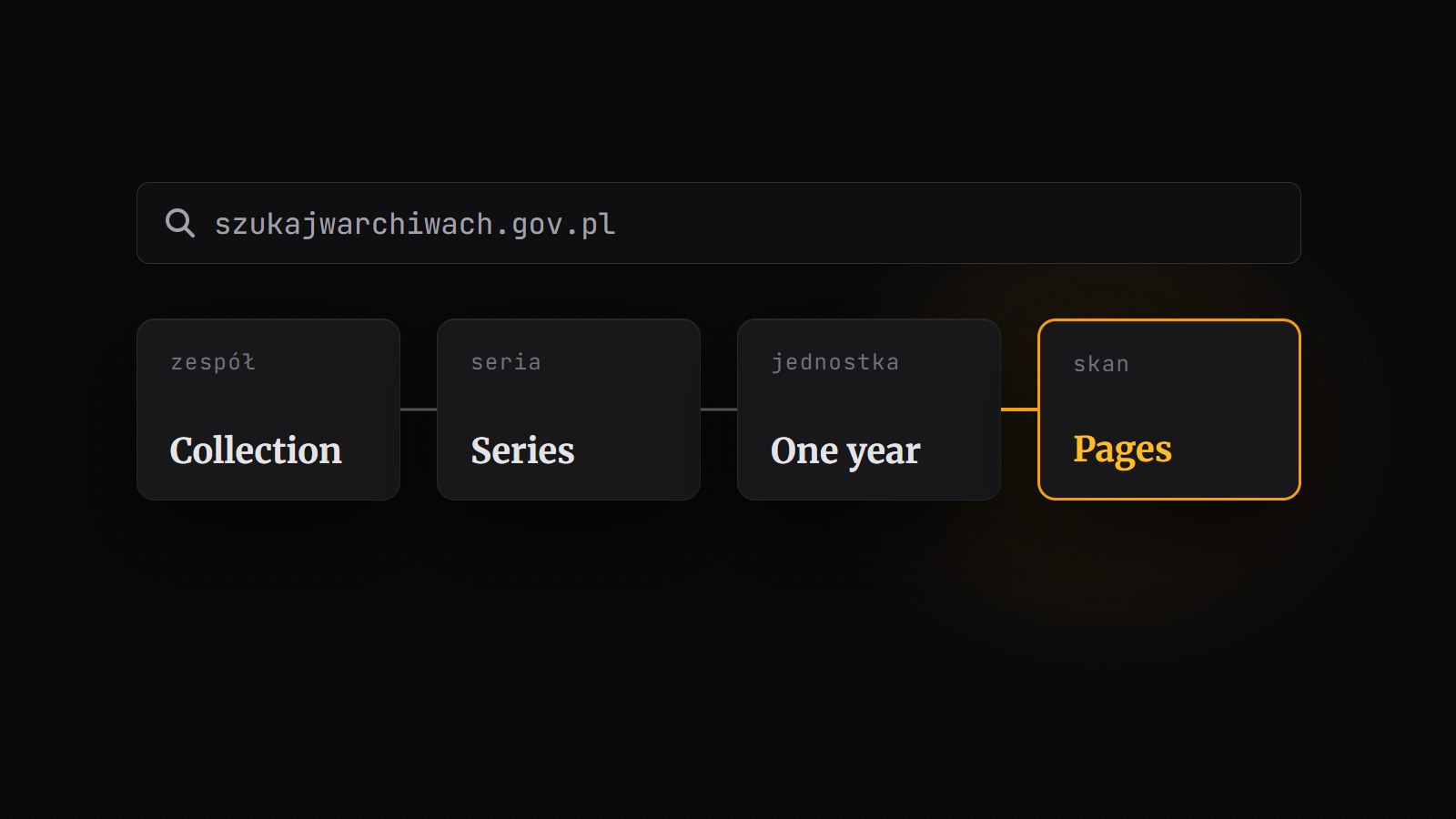
Once you are inside, the hierarchy runs zespół (collection) → serie (series) → jednostki (units) → skany (scans). For vital records, one unit is almost always one year, titled something like Akta urodzeń, małżeństw i zgonów 1841. Open a year and you get its scans.
A note on access: the portal was geo-restricted to Polish IP addresses for a stretch while the archives reworked their protections, and access from abroad has since been restored. Some researchers outside Poland still report the site loading slowly or refusing connections entirely, and routing through a Polish VPN endpoint remains the standard workaround when that happens. It should not be necessary under normal conditions.
Step 2: Check the name indexes that already exist
Before you read a volume yourself, spend ten minutes here. Sometimes it saves you the whole exercise.
Geneteka, run by the Polish Genealogical Society, is the big one: over 68 million indexed entries, free, no login, covering Poland and parts of Ukraine, Lithuania, and Belarus. Coverage is heaviest for Roman Catholic parishes but it marks denomination explicitly, with Jewish records tagged mojż and Lutheran ewang.
JRI-Poland has indexed over six million Jewish birth, marriage, and death records. For Biała Podlaska, for example, the 1826-1902 indices are searchable there, along with an indexed 1939 Jewish census of the town.
Note the scope, because the name understates it: JRI-Poland covers the current and former territories of Poland, which means all three partitions, not just Congress Poland. Galicia (the Lwów, Stanisławów and Tarnopol areas, now in Ukraine) and the Prussian provinces (Posen, East and West Prussia, Silesia, Pomerania, Brandenburg) are all in there, and you can search by region as well as by town. Jewish researchers whose families were Galician or Prussian frequently skip it on the mistaken assumption that it is a Russian-partition resource.
JewishGen aggregates much of this alongside Yizkor books, cemetery data, and community histories, and FamilySearch has microfilmed a great deal of the same material, increasingly available as browsable images.
Now the honest part. These indexes are volunteer projects, and using them in practice is less tidy than describing them:
- Coverage stops where the volunteers stopped. A town might be indexed to 1875 and no further, or have births done and deaths untouched. An absent entry is not evidence of an absent record.
- A hit often does not tell you where the record is. Many entries carry the year and act number but no archival reference, no collection number, and no link through to the images. Where image links do exist they are usually a separate volunteer effort layered on top of the index, added town by town, so most towns have neither. You still have to identify the right collection and the right unit yourself.
- Even a link is not always the right page. Image links tend to point at page level rather than at the individual act, and some drift as the underlying archive inventories are reorganised. Landing a few scans away from your record is normal. You know the year and the surname, so flip forward or back until you hit it.
- The index is a transcription of a transcription. Names get normalised, numbers get transposed, and the act itself may say something meaningfully different.
So treat these as a shortcut worth trying, not as the source. Even a successful search usually deposits you back at the archive needing to find one scan among several hundred, and the next two steps solve that problem.
Step 3: Find the index pages inside the year
Open the year's scans and do not start at the beginning. Skim the thumbnails and look for pages that are visually different from all the others.
Records are written as dense paragraphs. Indexes are columnar lists: a name, then a number, line after line. Once you know that, you can spot them at thumbnail size without reading a word.
What to expect:
- Order within the volume. Births (urodzenia) first, then marriages (małżeństwa or zaślubiny), then deaths (zgony). Not every volume has all three, and not every year is complete.
- Where the indexes sit. Sometimes each index follows its own record section; sometimes all of them are grouped at the very end. Check both ends before concluding there is none.
- How many. Usually one to three pages per record type, depending on how busy the year was.
- What they are called. Skorowidz or Indeks, though many are unlabelled.
- How alphabetical they really are. Some are fully alphabetised by surname. Many are grouped by first letter only, with entries inside each letter left in registration order. Some are alphabetised by given name. That is not an error: especially in Jewish and early Catholic records, it reflects how recently fixed surnames had arrived.
Download the index pages. The scan viewer has a download control in its side panel; take the highest resolution offered.
Step 4: Have the index read for you
This is where the time goes if you do it by eye. An index page is the hardest thing in the volume to skim: a hundred names in a clerk's shorthand, no sentence context to lean on, no surrounding words to help you guess a letter, and after 1868 in the Russian partition, in Cyrillic.
Instead, hand the page over. In KleioBase, open the Research Companion, attach the index scan with the paperclip button, and ask a direct question:
This is the birth index from the Jewish civil registers of Biała, 1841, written in Polish. List every entry whose surname begins with N, B, or P. Give me a table with surname, given name, and the akta (record) number.
You get back a short table instead of a page of handwriting. Attaching a file to a conversation this way does not consume an upload credit. It is answered inside the chat, and the file stays in the conversation's Files panel so you can come back to it.
Some practical refinements:
Filter by your surnames, not by everything. If you know which family names you are chasing in that town, name them. You get a list you can act on in a minute rather than a transcription of two hundred strangers.
For a small village, ask for everything. If the year has forty births, take all forty. In a small community nearly everyone is connected to everyone, and knowing the whole population of a year is more useful than knowing three names from it.
Ask about near-misses on purpose. Spellings in these records are unstable, and the clerk was writing what he heard. Ask for surnames beginning with your letter and anything phonetically close. Nuchowicz, Nuchimowicz, and Nachimowicz can all be one family across three clerks; so can Wójcik, Woycik, and Voytsik.
Verify before you celebrate. The index is a clerk's copy of a clerk's work. Numbers get transposed, entries get skipped, and an index that does not list your ancestor is not proof the record is absent. The index tells you where to look. The act is the evidence.
Step 5: Pull the record and upload it with context
Go back into the year's scans and find the number the index gave you. Record numbers are written large in the margin of each act and run in sequence, so they are easy to spot once you are in the right section.
Numbering restarts for each record type. A volume for 1841 can contain a birth act 96, a marriage act 96, and a death act 96. If your index entry came from the birth index, count within the birth section. Landing in the deaths and finding the wrong person is the most common way this goes wrong.
Download that single scan. This time, upload it to your archive through the upload workspace instead of attaching it to a chat, so it gets transcribed, translated, and turned into structured people, dates, and places that connect to the rest of your tree.
Before processing, fill in the Context box. This is the step people skip and it is worth more than any other setting on the page. Tell it:
- the town and the historical name it appears under
- the year of the volume
- the record type and the act number
- the language: Polish, Russian, Latin, or German
- the surnames you expect to see
That last one matters most. Handwriting models are strongest on the formulaic parts of a record, which never change, and weakest on proper nouns, which have no context to constrain them, and those are the words you came for. Telling it that this act concerns a family named Nuchowicz turns an open-ended guess into a recognition problem. And you already have that surname: it came off the index in step 4.
What these records actually give you
The acts themselves hold far more than the index line that led you to them. Records from the Russian partition follow the Napoleonic long-paragraph form, and a single birth act typically contains:
- The exact date, place, and hour the act was drawn up, opening with Działo się ("It happened in...").
- The father presenting the child (Stawił się), with his age, his occupation, and where he lived.
- Two witnesses, with their ages and occupations.
- The mother's given name, her maiden surname, and her age.
- The child's name, sex, and the exact date and hour of birth.
That is two generations, two approximate birth years, an occupation, and a residence, from one act. Death records give an age at death and often name the parents of the deceased, reaching back a further generation. Marriage records name both sets of parents and usually state where each spouse was born.
Often it is three generations, not two
Most guides leave this detail out. Look for it on every record.
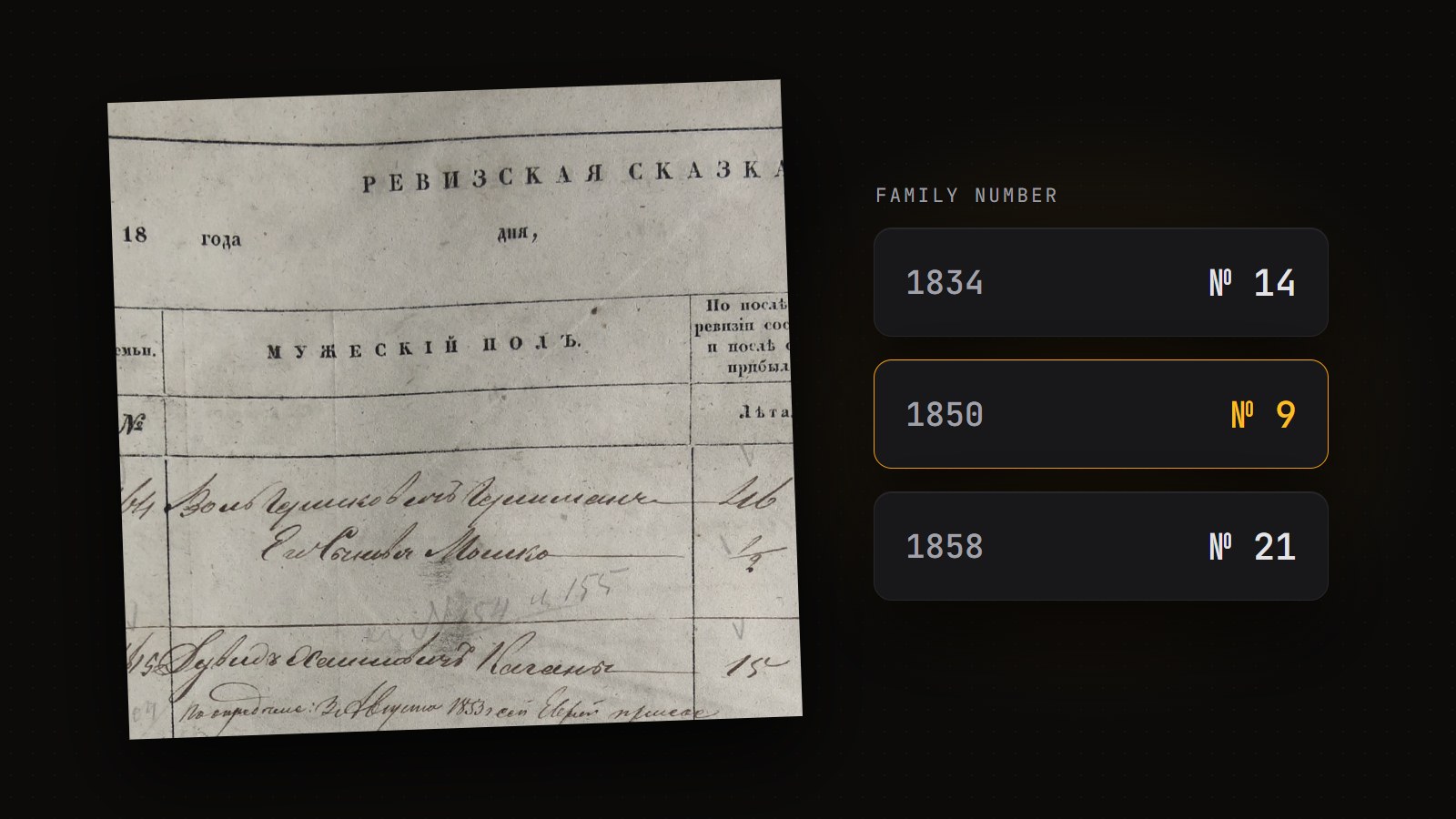
Parents in these acts are frequently named with a patronymic as well as, or instead of, a surname. A father recorded as Moszek Nuchimowicz is Moszek, son of Nuchim. In Russian-language records from 1868 onward the patronymic is a standard part of how a person is named, so it appears routinely; in the Polish-language years it turns up more sporadically, and it can appear for the mother as well as the father. Where both parents carry one, a single birth record has just handed you both grandfathers' given names.
Two cautions before you build on it. In the earliest decades, many Jewish families had no fixed surname at all, and individuals appear with a given name and a patronymic only, so what looks like a surname may be a patronymic, and the "surname" can change every generation. And the patronymic used in a registration was sometimes the father's name and sometimes the grandfather's, and it is not always consistent across siblings in the same family. Treat a patronymic as a strong lead about the previous generation, then confirm it against a second record before you draw the line on your tree.
Do not skip the supplements. Marriage files (alegata), which hold copies of birth certificates, sworn statements of identity used when a birth record could not be produced, and official corrections, were bound and kept alongside the registers. In the Biała collection they survive for 1834, 1836, 1844, 1855, 1873, 1875, 1878, 1881-1882, 1890, 1892, 1894, 1899, 1901, 1904, and 1906. A single marriage supplement can hand you a birth record from a completely different town, which is often how a family's earlier origin finally surfaces.
If your records are Jewish
Three things are specific to the Jewish civil registers and worth knowing before you misread one.
The witnesses are often not relatives. From the 1820s onward, the witnesses in Jewish acts are frequently the same two men year after year: a szkolnik or podszkolnik, minor synagogue officials serving as professional witnesses. Do not build a relationship out of them. Conversely, in the earliest years witnesses were more often family, so an 1820s witness is worth a second look.
Surnames were still settling. Jews in the Kingdom of Poland were ordered to declare fixed hereditary surnames in 1821, but enforcement was weak, and it was the Russian statutes of 1835 and 1844 that finished the job. In records from the 1820s and 1830s you will meet patronymics used as surnames, families recorded under two different names in different years, and given names appearing in a Polish form in the civil act and a Hebrew one in the community's own books. Treat name variation as normal, not as a mismatch.
Registration was often late or skipped. Because these were secular acts rather than religious ones, compliance was inconsistent, and the archives themselves note that the Jewish population frequently did not register events on time. A birth recorded in 1843 may have happened in 1841.
If your records are Catholic
Catholic registers in the Russian partition use the same Napoleonic paragraph form and the same annual duplicates, so everything above applies directly. Two differences: baptism dates and birth dates are both given and are not always the same day, and in the Prussian and Austrian partitions Catholic records are more often in Latin and laid out in ruled columns rather than paragraphs, which changes what you are skimming for. Columnar records are easier to read and easier to misalign; check that you are reading across the correct row.
Working year by year
The method pays off most after the third or fourth year. Because you are moving through a town's registers chronologically rather than hunting one name at a time, you stop collecting isolated documents and start watching a community.
You see a couple marry in 1838, their children arrive in 1840, 1842, 1845, one dies in infancy in 1846, the father's stated occupation shifts from handlarz to kupiec, and the same handful of surnames keeps reappearing as witnesses and in-laws until you can see who married whom in that town. That accumulated picture answers far more questions than any single record does.
This is also where an archive that connects records to each other pays off against a folder of scans. Each act you process adds people, dates, and places that are matched against everyone already there, so an 1845 birth record attaches itself to the 1838 marriage you did last week. You can then ask questions a filing system cannot answer: who is missing a death record, which children have no follow-up after a given year, whether two similar names are one person. See how AI changes this kind of research for where that helps and where it does not.
Quick reference: terms you will meet
| Polish | Meaning |
|---|---|
| akta stanu cywilnego | civil registration records |
| parafia rzymskokatolicka | Roman Catholic parish |
| okręg bóżniczy | Jewish (synagogue) registration district |
| parafia ewangelicko-augsburska | Evangelical Lutheran parish |
| akt / nr aktu | act, record / record number |
| urodzenia, chrzty | births, baptisms |
| małżeństwa, śluby, zaślubiny | marriages |
| zgony | deaths |
| skorowidz, indeks | index |
| alegata | marriage supplements |
| unikat / duplikat, wtóropis | original book / annual duplicate |
| zespół | collection (fond) |
| jednostka | archival unit, usually one year |
| sygnatura | reference code |
| skany | scans |
Start with the index
Nothing above depends on your family being from any one town or belonging to any one faith. Every parish and every registration district in Congress Poland kept its books under the same code, on the same forms, in the same two languages, closed with the same annual indexes. The Prussian Standesamt offices did much the same from 1874, and even in Austrian Galicia, where indexes are unreliable, the registers themselves are tables you can read the same way. The catalogue works identically whichever collection you open.
Find the collection under the town's historical name. Open a year. Find the index. Read the index instead of the whole volume. Pull the numbered acts you want, and give the extraction the context you already learned from the index.
Records that survived partition, two world wars, and a century of moved borders are sitting on a public server, free, waiting for someone to read them. Often the only thing standing between you and your family's names is the order in which you open the pages.
Follow KleioBase on Google
Add us as a preferred source to see our research guides more often in Google Search and AI results.
Start building your family history
Upload a record and let KleioBase transcribe, translate, and connect it - all in one place, with a research partner that remembers everything you find.
Get started