There is a particular kind of confusion that comes with ancestors from western Poland. The family called themselves Polish. The records call them German. The town has two names, and the one on the ship manifest is not the one on the map. Half the paperwork is in a script nobody can read, and the archive that holds it might be in Poznań or it might be in Berlin.
This is the Prussian partition, and it is the best-documented and worst-understood corner of Polish genealogy. Prussia took these territories at different times, which is worth knowing because it sets how far back the German-administered paper trail runs: Silesia from the 1740s, West Prussia in the first partition of 1772, and the Greater Poland lands that became the Province of Posen in the second partition of 1793, reorganised as the Grand Duchy of Posen after the Congress of Vienna in 1815. Prussian rule over all of it ran until 1918, latterly as part of the German Empire, and records were kept to German standards.
Prussian record-keeping was thorough and much of it survives. This region also has a free name index that does something no other Polish genealogy database does, and most people have never heard of it.
First: two eras, two systems
Everything about researching this region depends on which side of one date your event falls.
| Period | Who registered | Language | Where the records are |
|---|---|---|---|
| Before October 1, 1874 | Churches: Catholic parishes and Evangelical (Lutheran) parishes | Latin (Catholic), German (Evangelical) | Polish state archives, diocesan archives, some German church archives |
| From October 1, 1874 | The state, through civil registry offices (Standesamt) | German to 1918, Polish after | Polish state archives, local registry offices, Standesamt I Berlin |
The 1874 line is hard. Before it you are reading church books. After it you are reading government forms. They look nothing alike and they are catalogued separately.
The Russian partition is different: there a single Napoleonic system ran from 1808 into the 20th century. If you have researched a Congress Poland family before, its structure does not carry over. (Everything you need for this region is below; our guide to the Polish State Archives covers the Russian partition separately.)
Start with the Poznań Project
Before you open a single scan, go here.
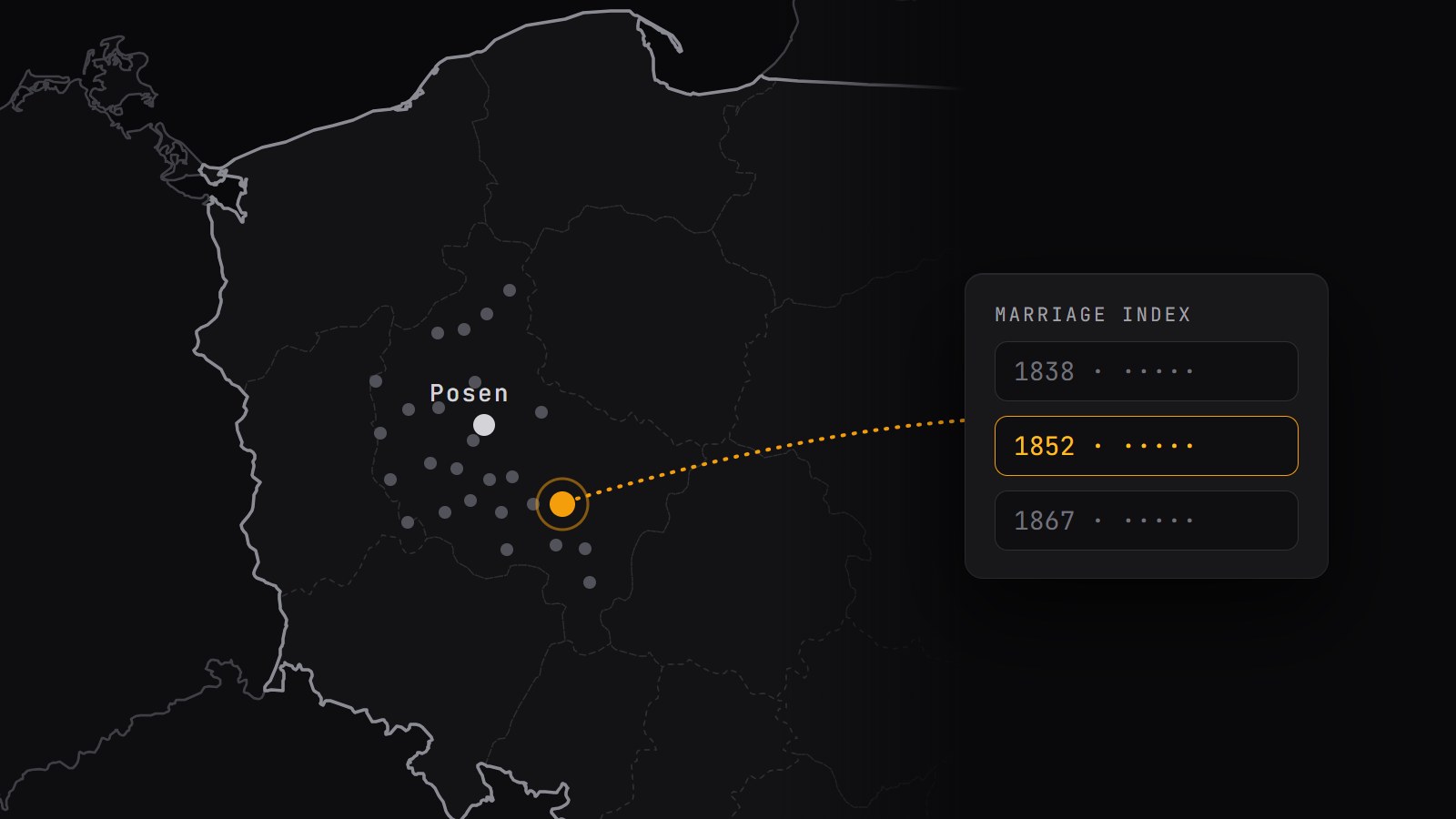
The Poznań Project, a volunteer indexing effort coordinated by Łukasz Bielecki since 2000, has indexed more than two million 19th-century marriages from the Catholic parishes, Protestant congregations and Prussian civil registry offices of the former province of Posen. Its own project page counted 2,021,293 marriage entries in January 2026. It is free and searchable by name.
What sets it apart is what gets indexed. Most marriage indexes capture the bride and the groom. The Poznań Project indexes every named person in the record: groom, bride, the groom's parents, the bride's parents, the witnesses, and sometimes the officiating clergy.
Your ancestor does not have to have married in Posen for you to find them. They can turn up as somebody else's father-in-law, or as a witness at a neighbour's wedding in 1863. In a region where families intermarried within a handful of villages for generations, being able to search the witnesses changes what you can find, and nothing in the Russian or Austrian partitions has an equivalent.
Two limits worth knowing. It covers marriages only, and it covers the Posen province only, so Pomerania, Silesia and West Prussia are outside it. If your town is outside Posen you will need to work from the archives directly.
What happened to the Poznań Project? It is still running, but it goes offline
If the site will not load, the project has not shut down. It is a volunteer effort rather than an institution: Bielecki coordinates it, volunteers in many countries do the indexing, Maciej Głowiak wrote the search engine, and the Poznań Supercomputing and Networking Center lends the servers. The Wielkopolska genealogical society "Gniazdo" supports it. That arrangement has kept it alive for a quarter of a century, and it also means nobody staffs it around the clock.
It goes down from time to time. Users on the PolishOrigins forum reported it unreachable in July 2023, with no reason given. It did not load for us on 8 October 2026 either, although the Internet Archive had captured it answering normally on 27 September 2026.
The site looks abandoned, and that misleads people. The newest item in its news section is dated January 2015, and it announces the project's Twitter account. The database behind it kept growing long after that: the 2,021,293 figure above comes from a page captured in 2026.
What to do while it is down:
- Wait and try again at the same address. Bielecki moved the project to poznan-project.psnc.pl in February 2012 and it has not moved since, so a dead link elsewhere is not a sign it relocated.
- Check for news where the project posts it, which is the @PoznanProject account on X and the long-running "Poznan Project - indeks małżeństw Wlkp" thread on the Gniazdo society's forum.
- Search the neighbouring indexes in the meantime. BaSIA covers the same region from the archives' side, and Geneteka covers all of Poland. Coverage differs parish by parish, so a miss in either is inconclusive, not a negative result.
From an index hit to the actual image
An index entry is a lead, not a source. To see the record itself:
BaSIA (Baza Systemu Indeksacji Archiwalnej), run by the Wielkopolska Genealogical Society, holds more than four million indexed entries from across Wielkopolska, drawn from both state and church archives, and many entries link directly to scanned images. The Poznań Project and BaSIA are designed to work together.
Szukaj w Archiwach, the Polish State Archives portal, holds the scans themselves for material in state custody. Geneteka also covers this region.
Two more databases people miss here
JRI-Poland, if your family was Jewish. The name misleads: it indexes Jewish vital records from the current and former territories of Poland, and that includes the whole Prussian partition: Posen, East Prussia, West Prussia, Silesia, Pomerania, and Brandenburg. You can search by surname within a region, and results give the exact archival location of the original document. Jewish researchers with Posen ancestry routinely skip it on the mistaken assumption that it is a Congress Poland resource.
The Poznań Population Register, 1870-1931. A database of roughly 1.13 million people who lived in the city of Poznań, permanently or temporarily. This is a residence register rather than a vital record, which makes it a different kind of instrument: it can place a person in a city at a date, show when they arrived and left, and catch people who were born and died elsewhere and would never appear in the city's own birth or death books. If your family passed through Poznań rather than settling there, this may be the only record of it.
Finding the collection yourself
When the indexes do not cover your town, your years, or your record type, you go to the archive catalogue directly.
Go to szukajwarchiwach.gov.pl, the Polish State Archives portal. There is an English toggle in the top right, and you do not need an account to browse or view scans. It is not a name index, so searching for your ancestor will return nothing. You search for the office that created the records (a parish, or a Standesamt) and then work through its volumes yourself.
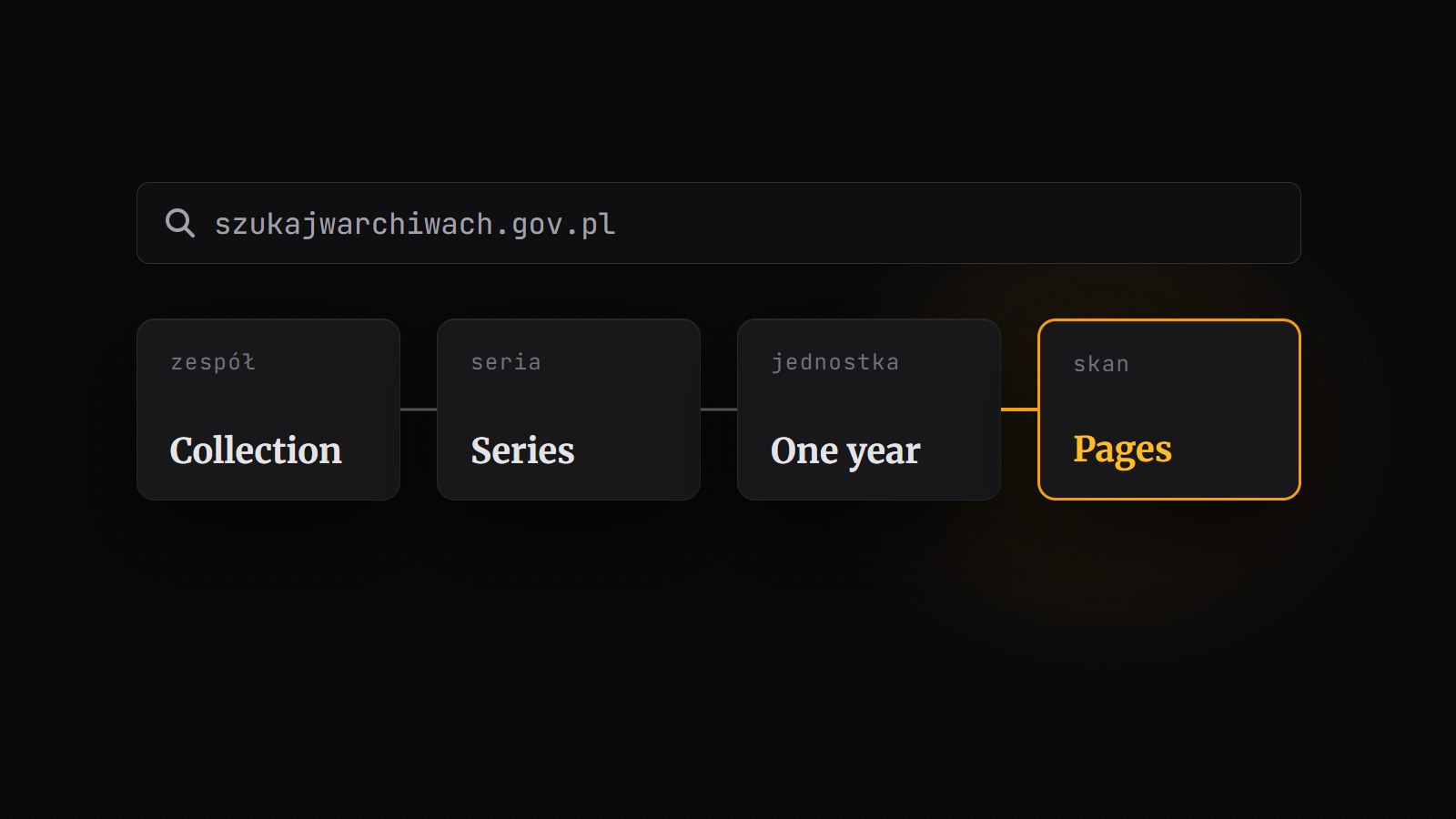
Once you find it, the hierarchy runs zespół (collection) → serie (series) → jednostki (units) → skany (scans). A unit is usually one year of one record type, and opening it gives you that year's images. The scan viewer has a download control in its side panel; take the highest resolution offered.
Two further things are specific to this region.
The town has a German name
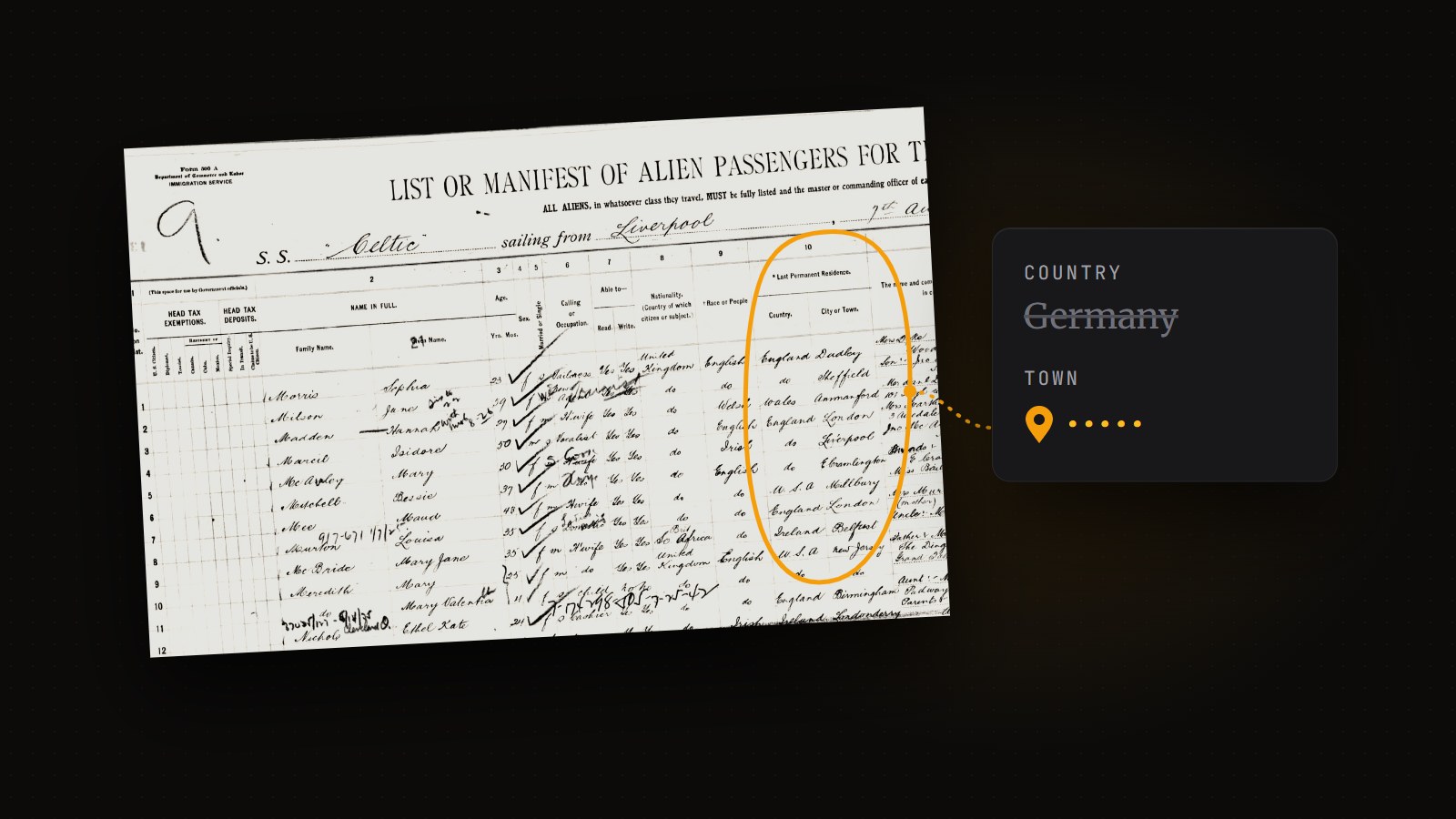
This trips up more people than anything else. Nineteenth-century Prussian records use the German place name, and archives catalogue under the modern Polish one. Posen is Poznań. Bromberg is Bydgoszcz. Breslau is Wrocław. Thorn is Toruń. Every village has a pair like this, and the German name is usually what appears on emigration papers and in family memory.
A gazetteer that maps German to Polish names, such as Kartenmeister, is close to essential before you start searching. Get the modern Polish name first, then search the catalogue.
The records are split across two countries
Prussian-era records did not all end up in one place, and where yours are depends on what happened to that territory after 1945.
- Polish state archives hold most surviving registers for territory that is now Poland, published through Szukaj w Archiwach.
- Local registry offices (USC) still hold volumes recent enough to be restricted.
- Standesamt I Berlin officially holds civil registration duplicates for former German territories, and is the fallback when the Polish copy is missing.
- German church archives, including the Evangelical central archive in Berlin and the Archion portal, hold or have digitised many Evangelical parish books.
A blank in the Polish archives exhausts only one copy of the record.
What a Standesamt register looks like, and why the index matters
From October 1874, every birth, marriage, and death was reported to a civil registrar and written onto a standardised printed form. The forms are dense but consistent, and once you have read one you can read all of them.
A birth entry gives the child's name, sex, date, time, and place of birth, the parents' names, the father's occupation and religion, the family's residence, and the informant. A marriage entry gives both spouses' names, ages, birthplaces, occupations and residences, both sets of parents, and two witnesses with their ages and occupations. A death entry gives the deceased's name, age, occupation, place and time of death, and who reported it. Later corrections often appear as marginal notes added years afterwards, sometimes decades later, and they can be the most valuable thing on the page.
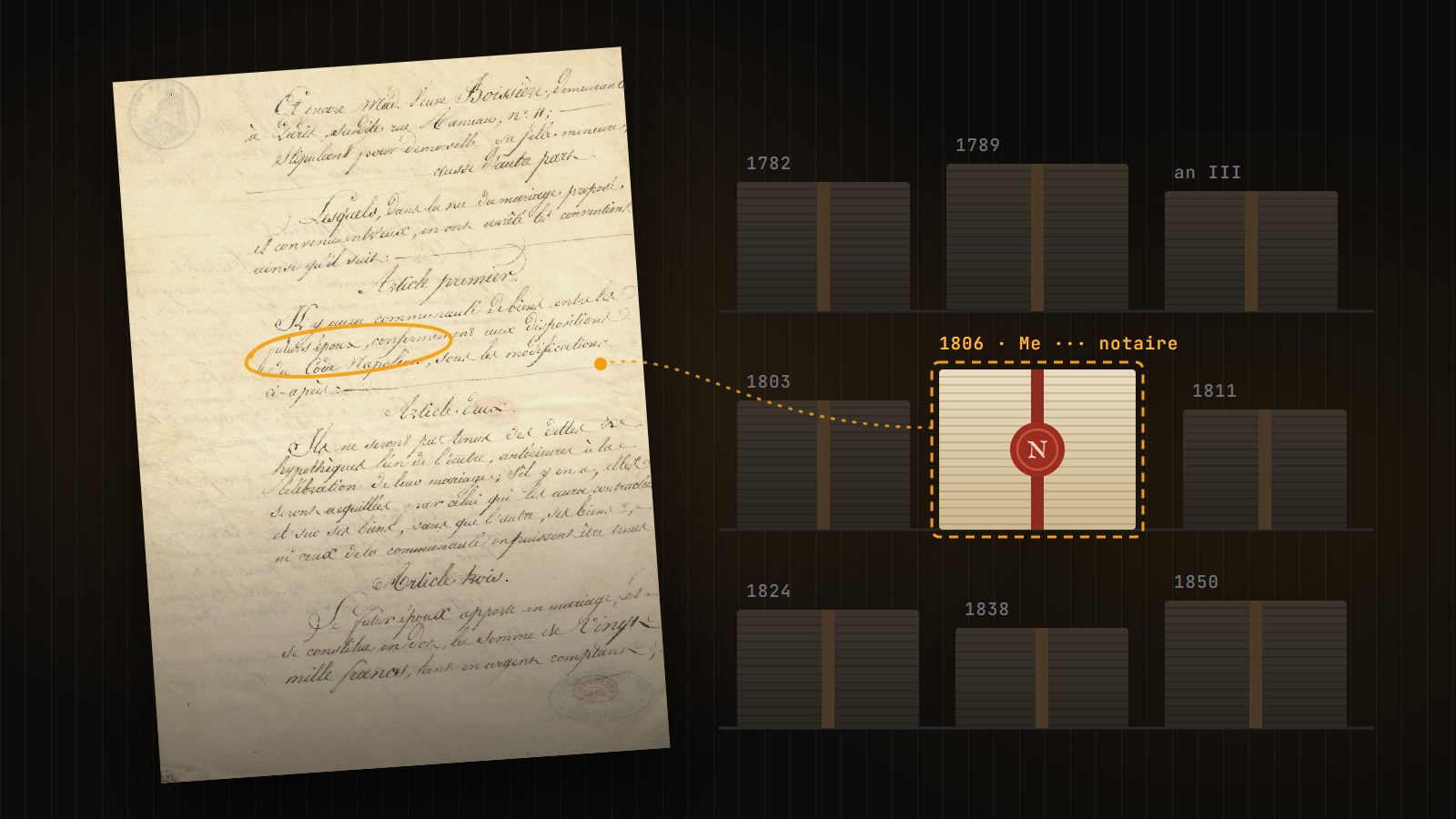
This region is tractable because indexes were prepared yearly, and births, marriages, and deaths were each indexed separately. These alphabetical surname indexes accompany the registers themselves.
That is the same structural gift the Russian partition offers, and it supports the same approach.
The index-first method
- Open the year and the record type you want in the archive collection.
- Skim the thumbnails for the index. It looks different from everything else: a columnar list of surnames and numbers rather than filled-in forms. It sits at the start or the end of the year's run.
- Download the index pages and have them read for you. In KleioBase, open the Research Companion, attach the scan, and ask directly:
This is the annual name index from a Prussian Standesamt birth register, 1889, in German Kurrent script. List every entry whose surname begins with K or W, and give me a table with surname, given name, and the entry number.
- Take the numbers you get back, find those entries in the register, and download only those scans.
Two cautions specific to Prussian indexes. They are sometimes incomplete or missing entirely for a given year, so an absent name is not proof of an absent record. And the spelling in the index frequently differs from the spelling in the entry itself, because the clerk indexing was normalising as he went. Ask for phonetic near-misses, not just exact letters.
The handwriting problem
Prussian records are in German, and German before the 1940s was handwritten in Kurrent, a script so different from modern cursive that fluent German speakers today usually cannot read it. Early 20th-century records may be in Sütterlin, a simplified teaching form of the same script. Printed headings on the forms are in Fraktur.
This is the single biggest practical barrier in this region, and it is worth understanding rather than working around blindly. We have a full guide to reading Kurrent and Sütterlin, including why the script vanished from German schools in 1941 and which letterforms cause the most misreadings, plus a reference on German genealogy records generally.
For the pre-1874 Catholic church books you have the opposite situation: the records are in Latin, usually in ruled columns, and Latin parish vocabulary is small and highly repetitive. Once you know natus (born), baptisatus (baptised), copulati (married), mortuus (died), and the month names, a Catholic register page becomes readable quickly.
Access restrictions depend on who holds the copy
This catches people out, because the same record can be open in one country and closed in the other.
In Polish archives, the usual rules apply: birth records restricted for 100 years, marriage and death records for 80. Volumes stay with the local registry office until every entry inside is out of restriction.
In German custody, the German civil status law sets different periods: births open after 110 years, marriages after 80, deaths after 30.
So a 1900 death record may be freely available through a German office while the Polish copy is still sitting in a registry office, or the reverse. When one route is closed, check the other before concluding the record is unavailable.
Processing what you find
Once you have the scan, upload it through the upload workspace rather than leaving it in a folder, and fill in the Context box before processing. For this region that means:
- the town under both its German and Polish names
- the year and the record type
- the language: German for Standesamt and Evangelical books, Latin for Catholic ones
- that the script is Kurrent, if it is
- the surnames you expect, which you already have from the index or the Poznań Project
Proper nouns are where handwriting recognition is weakest, because unlike the formulaic parts of a form they have no surrounding context to constrain them. Supplying the surname you are expecting turns an open guess into a recognition task. It is the cheapest accuracy improvement available.
From there each record adds people, dates, and places that get matched against everyone already in your archive, so an 1889 birth attaches itself to the 1878 marriage you processed last week without you filing anything.
Quick reference: German and Polish terms
| Term | Meaning |
|---|---|
| Standesamt | civil registry office (from 1874) |
| Geburten / Geburtsregister | births / birth register |
| Heiraten, Trauungen | marriages |
| Sterbefälle, Verstorbene | deaths |
| Namensverzeichnis, Register | name index |
| Kirchenbuch | church book, parish register |
| evangelisch / katholisch | Evangelical (Lutheran) / Catholic |
| Kreis | district |
| Urząd Stanu Cywilnego (USC) | Polish civil registry office |
| akta stanu cywilnego | civil registration records |
| zespół / jednostka / skany | collection / archival unit / scans |
Where to start tomorrow
If your town was in the Province of Posen, search the Poznań Project first, by surname, with no other assumptions. Follow any hit into BaSIA or Szukaj w Archiwach for the image.
If your town was in Pomerania, Silesia, or West Prussia, go to Szukaj w Archiwach directly. Convert the German place name to Polish first, decide whether your event is before or after October 1874, find the right collection, and then work the annual index rather than the whole year.
Either way, the thing to hold onto is that Prussian bureaucracy was relentless about writing things down and indexing them. That was inconvenient for your ancestors and it is extremely convenient for you.
For the Russian partition, see our guide to the Polish State Archives. For Galicia and the Austrian partition, see Austrian Galicia records.
Follow KleioBase on Google
Add us as a preferred source to see our research guides more often in Google Search and AI results.
Start building your family history
Upload a record and let KleioBase transcribe, translate, and connect it - all in one place, with a research partner that remembers everything you find.
Get started