You have found the civil marriage. It is in the état civil of a small town in 1856, in a clerk's tidy French, and near the end, after the witnesses, there is a sentence you nearly skipped: the couple declared that a marriage contract had been received on a certain date by Maître So-and-so, notary at a town ten kilometres away.
That sentence is a pointer to a second document, and often a richer one. The contract will list what each of them brought to the marriage, and it may name parents, siblings, uncles and godparents who came to sign. But it is not in the civil register, it is not in the parish register, and in most cases nobody has indexed it. It is in that one notary's bundles, among his sales, leases and loans for the same month.
Most of the work with French notarial records is finding the right notary, and the rules about where his papers now live changed more recently than many guides say.
The short answer. French notarial records (minutes notariales) are the original deeds a notary drew up: marriage contracts, wills, inventories after death, divisions of estates, guardianships, sales and leases. They are kept notary by notary, in date order, and most are not indexed. Once they are 75 years old they are public, and notaries are required to deposit them with the Archives départementales of their département, under series E, or for Paris with the Archives nationales' Minutier central. That 75-year rule dates from the archives law of 15 July 2008 and a notarial circular of December 2009, and some guides still give older thresholds of 100 or 125 years. To find which notary to search, start with the marriage act itself if it is after 1850, then the tax registers: the contrôle des actes from 1693 to 1790 and the enregistrement from 1791, both of which logged notarial acts by date and often index the parties by name.
A notary's minutes are the originals, kept in his office
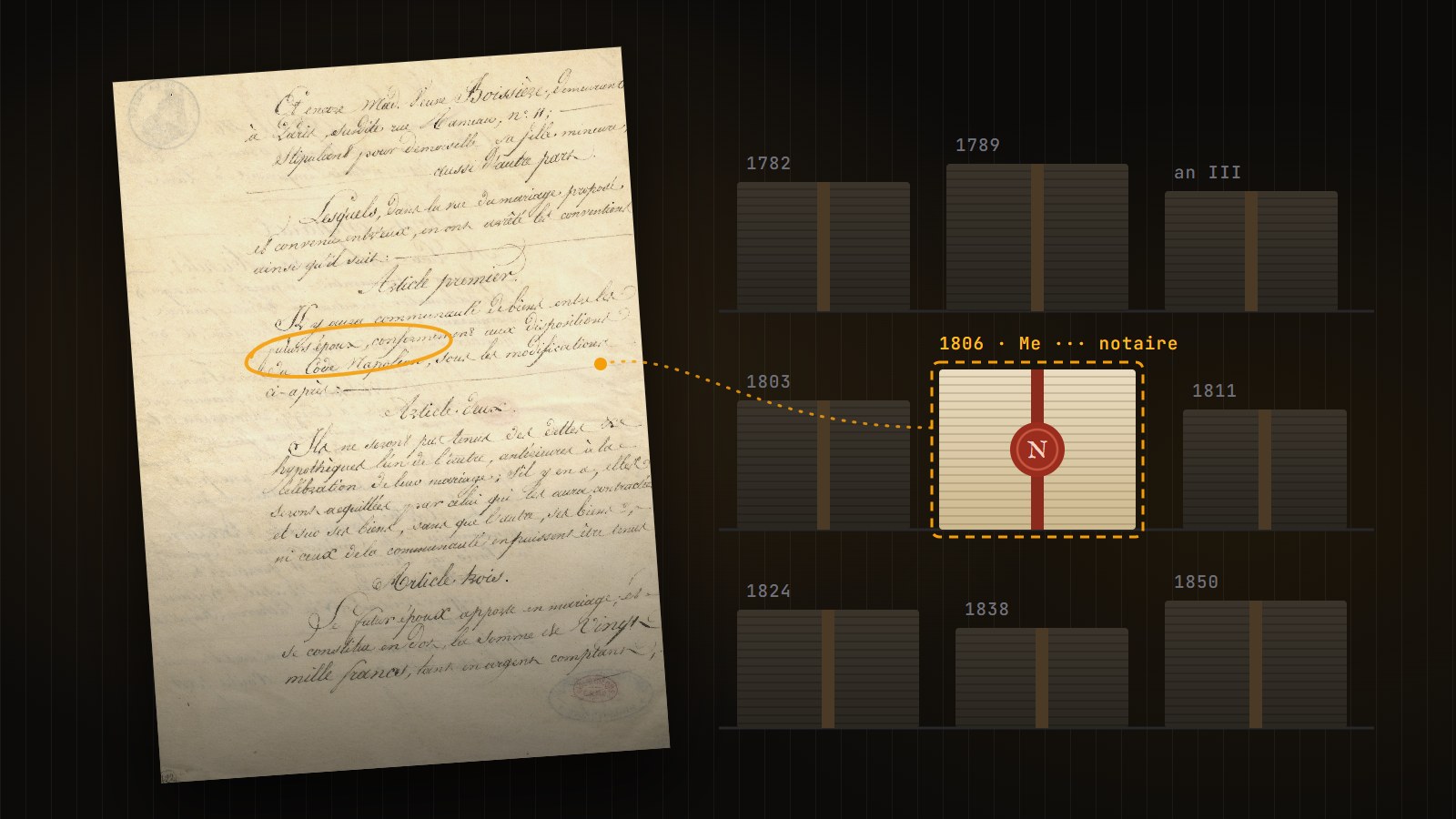
A French notary kept the signed original of every deed, the minute, in his office, filed by date. Alongside the minutes he kept a répertoire, a running chronological list of the acts he received. When he left, the office and its papers passed to his successor, which is why, as FamilySearch's wiki puts it, some notarial records may still be in the office of the notary's successor.
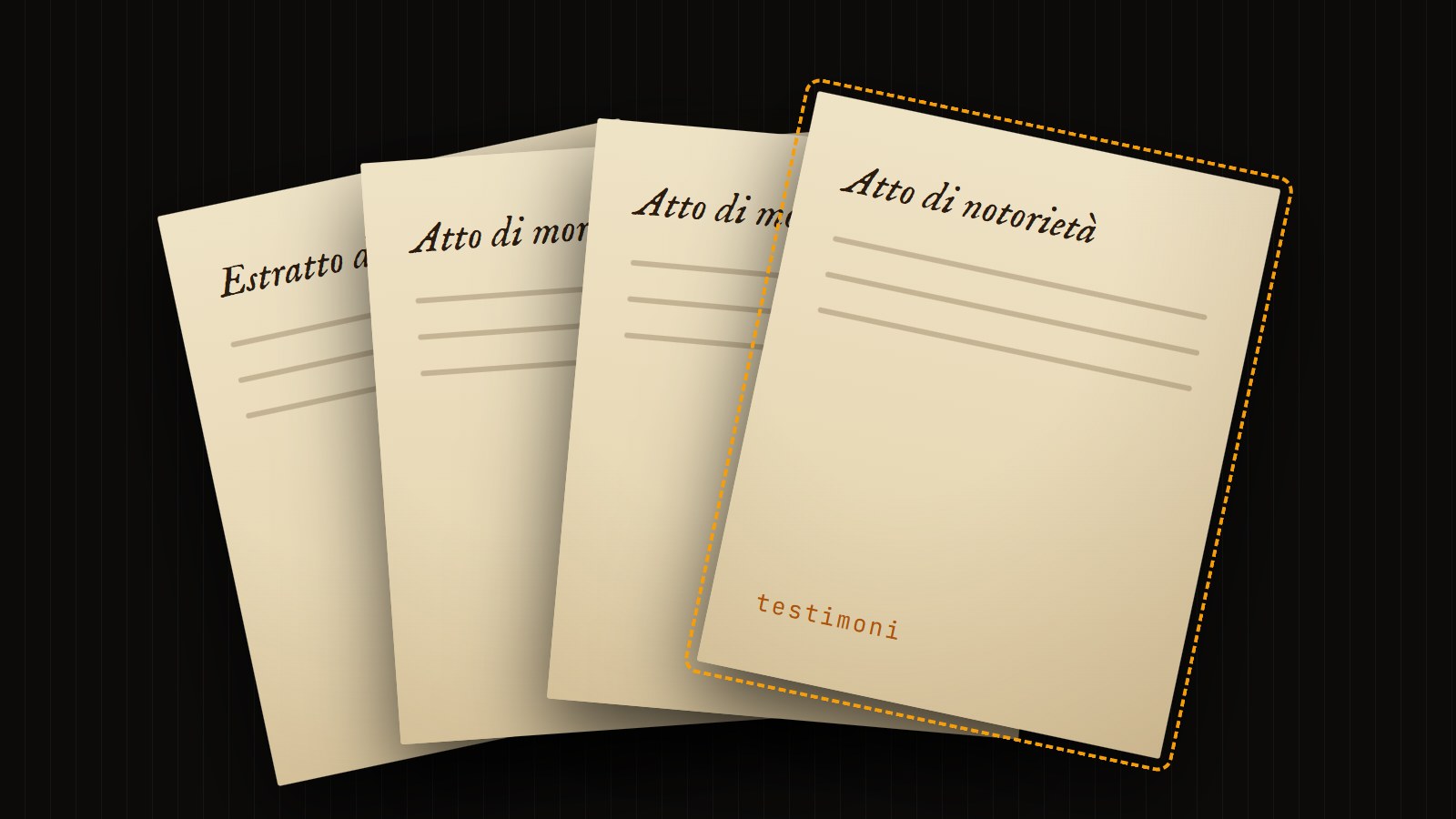
FamilySearch's research wiki lists the kinds of record a family historian will meet: marriage contracts (contrats de mariage), wills (testaments), divisions of property among heirs (partages and successions), inventories of a household taken after a death (inventaires après décès), and guardianship agreements for minor children when a parent died (actes de tutelle). It notes that in many of them the names and relationships of all the family members and friends present are given, and that researchers sometimes use notarial records from as early as the 1300s, older than the parish registers in many places.
They sit among everything else the notary did. The same wiki points out that each notary's records are usually in date order, so your family's contract sits between land conveyances, bonds and partnerships. There is no separate series for marriages. If you know the notary and the date, you can find the act in an afternoon. If you know neither, you can spend weeks.
Where the minutes are now depends on their age and their town
Three places, decided by two facts: how old the act is, and whether the notary practised in Paris.
Outside Paris, over 75 years old: the Archives départementales. Minutes and répertoires of notaries are public archives under article L211-4 of the Code du patrimoine, and once they become freely communicable, after 75 years, they must be transferred to the departmental archives. The Archives départementales du Morbihan sets this out on its page for notaries, and it is where your search will usually end.
Inside Paris: the Archives nationales. The Archives nationales states that it receives only the archives of notaries of Paris intra-muros, through its Minutier central des notaires de Paris. Notaries outside the city deposit with their own département's archives.
Under 75 years old: usually still with the notary's successor. The 75 years run from the closing of the minutes and répertoires, or the records open 25 years after the death of everyone concerned if that comes sooner, according to the Archives départementales du Gard, which cites the law of 15 July 2008. Before then, the office that inherited the minutes still holds them.
The series letter is E, the number varies. In the French departmental filing system, notarial minutes belong to series E, but each département numbers its sub-series differently. The Essonne archives' guide to notarial archives, published in 2003, files them under 2 E. Morbihan says every reference to its notarial holdings begins with 6 E. Check the département's own finding aid before you assume a call number.
The deposit rule changed from 125 years to 75
If you have read that recent minutes are out of reach, you may have been reading an older rule.
| Date | Rule | Source |
|---|---|---|
| 14 March 1928 | Notaries may deposit archives older than 125 years with the departmental archives | Archives départementales de l'Essonne, 2003 |
| 3 January 1979 | Notarial minutes become public archives and must be deposited beyond 100 years | Archives départementales de l'Essonne, 2003 |
| 15 July 2008 | Archives law: minutes freely communicable after 75 years | Archives départementales du Gard |
| 16 December 2009 | Notarial circular CSN 2009-4 sets 75 years as the mandatory deposit period, aligned with communicability | Archives départementales du Gard |
FamilySearch's wiki page on French notarial records, read in October 2026, still says notaries are required to deposit records more than 125 years old, and adds that compliance is incomplete. The second half is still worth remembering, because deposits happen office by office and some run late. The first half reflects the 1928 law. For a marriage contract from the 1930s or later, the departmental archives may well hold it now, and it is worth checking their catalogue before you write to a notary's office.
After 1850, the marriage act names the notary
The easiest pointer is the one in the opening. A law of 10 July 1850 amended articles 75 and 76 of the Civil Code. The registrar now had to ask the couple whether they had made a marriage contract, and the marriage act had to record the answer: whether there was a contract, its date, and the name and place of residence of the notary who received it. A registrar who left it out could be fined.
So for a civil marriage after mid-1850, read the end of the act. If it says a contract was made, you have the notary, the town and the date, and you can go straight to his minutes. If it says no contract was made, you have saved yourself a search, and you have something worth writing down as negative evidence: a registrar asked, and the couple said there was no contract.
Before 1850, the marriage act does not tell you, and you need the tax registers.
Before 1791, the contrôle des actes tells you which notary
Notarial acts in France were registered for tax, and the tax produced its own registers, kept by a government office rather than by the notary.
The Archives départementales du Gard sets out how the system began. A royal edict of March 1693, in force from May that year, required notaries to bring their acts within 15 days to the nearest bureau du contrôle, which recorded each act's existence, date and essential terms. The Essonne guide adds that the clerks kept registers with a short analysis of each act, its date, the notary's name and the fee, and, mostly in the eighteenth century, tables by personal name. In Essonne itself, it says, the system was applied from 1695 to 1696, so the start date can vary locally.
This is the search that finds a notary you do not know. The registers are arranged by bureau, and the bureau covered several notaries, so a name table for your ancestors' bureau can show you that a marriage contract was made, when, and before which notary, even if you had never heard of him.
Where to find them. The registers are in series C of the departmental archives. The Gard holds its records in sub-series 2 C, covering 1693 to 1830 across 37 bureaux, and says that 107 registers of tables, 12,732 pages, have been online since February 2025. Other départements number the sub-series differently and have digitised different amounts, so check the archives of the département where the family lived.
An older layer exists for some acts. The Essonne guide notes that a separate registration, the insinuation, was created in 1539, at first for donations, a category that included wills and marriage contracts, and that its registers, in series B and later C, copied the acts out in full.
After 1791, the enregistrement does the same job
The Revolution replaced the contrôle with the enregistrement. The Gard archives date it to a decree of December 1790, put into operation from 1 February 1791, and note that many old registers stayed open and in use after that date.
The Essonne guide places the enregistrement records in sub-series 3 Q, and says that in practice they run from the Year VII of the Republican calendar, 1798 to 1799. As well as the registers of acts, the guide lists thematic tables by name, covering acts such as marriages, wills, donations, divisions and leases. One example it reproduces is a table of marriages for the bureau of La Ferté-Alais covering 1784 to 1810, which bridges the change of system. If the family's dates are written in the Republican calendar, our guide to reading dates in old records covers the conversion.
When the minutes are lost. The Essonne guide makes a point worth holding on to: if the minutes have disappeared, these other sources can at least give you the date, the notary's name or the content of an act. It also lists copies of notaries' répertoires filed with the authorities, in series L for 1791 to 1800 and sub-series 8 U for 1800 to 1940, which can rebuild a lost office's list of acts.
How to narrow the search when you have no pointer
The method below is ours, built from the guides above.
Start with the civil records. FamilySearch's wiki recommends working through civil registers and parish registers first, and only then the notarial inventories, because they give you the dates and places that the notarial search needs.
Find the bureau, not just the town. A contrôle or enregistrement bureau served a group of parishes or a canton. Work out which bureau covered the family's village in the decade you need, and search its name tables.
Expect the same notary across generations. The FamilySearch wiki notes that families did not always use the nearest notary, but once they had chosen one, they often stayed with him through several generations. A contract for the parents is a strong lead to where the children's contracts are.
Look for an association's index. The same wiki says that members of French genealogical associations sometimes compile indexes of notarial records, especially marriage contracts. A local cercle généalogique may already have done part of your search.
French-Canadian families used their notaries in the same way, and our piece on Quebec marriage contracts explains what such a contract can reveal clause by clause.
What KleioBase does with French notarial records, and what it does not
We are a tool in this space, so read this as disclosure.
KleioBase is an AI research companion that turns scattered historical records into one connected family archive. A French family is a good case for it, because the evidence for one couple is split between an état civil marriage, a parish baptism, a notarial contract and perhaps an inventory twenty years later, in different series of the same archive.
Upload a scan or photo of each page, as a JPG, PNG or PDF, and the French is read and translated, with the people, dates, places and relationships extracted for you to review before anything is saved. Our French records page covers the parish and civil records it reads, including dates in the Republican calendar, which it converts while keeping the original wording. The parents, siblings and witnesses named in a contract become people you can link to their own records, and when you ask the Research Companion about the couple, it answers from everything you have uploaded about them. A search of a bureau's tables that found nothing can be recorded against the person, with the bureau and years you covered.
There are three honest limits.
It will not tell you which notary to search. KleioBase reads the documents you give it. Working out the bureau, the notary and his series in the departmental archives is archive work you do first.
Its record-gap suggestions do not cover France. On the Researcher plan and above, Expected records suggests census and other targets for people in the countries it tracks, and France is not one of them.
A long act is many pages. An inventory after death can run to dozens of pages. Each page you upload becomes its own record, and a PDF takes up to 100 pages, so choose the pages that name people and property rather than uploading every page of every bundle.
Where to start with the family you already have
Take one couple married in France and find their civil marriage act. If it is after July 1850, read the last lines for a contract, a notary and a date.
If there is none, find the contrôle or enregistrement bureau for their village and search its name tables for the year of the marriage, and the year either parent died.
With a notary's name, open the departmental archives' finding aid for series E, find his office, and go to the bundle for that month. Read the répertoire first, if it survives, to get the exact date.
The notaries who kept these bundles were not writing for genealogists. They were protecting their clients' property, and every inventory of a dead man's linen and every clause about a bride's furniture was written so that a court could settle a dispute later. That care is why the papers are still there, filed in order, waiting for someone who knows which notary to ask for.
Follow KleioBase on Google
Add us as a preferred source to see our research guides more often in Google Search and AI results.
Start building your family history
Upload a record and let KleioBase transcribe, translate, and connect it - all in one place, with a research partner that remembers everything you find.
Get started