Two brothers are baptised in the same year. One record says 5 March 1650. The other says 15 March 1650. The villages are forty kilometres apart. Neither clerk made a mistake, neither record is a copy of the other, and the two boys were baptised on the same day.
One parish was Catholic and had been on the Gregorian calendar since 1583. The other was Lutheran and stayed on the Julian calendar until 1700. For one hundred and seventeen years, the two villages disagreed about what day it was.
This is the part of record work that almost nobody teaches. Researchers learn to read the handwriting, learn the vocabulary, learn where the archives are, and then enter a wrong date into a family tree because the number on the page looked unambiguous. Every date in a historical record belongs to a system, and you have to know the system before the number means anything.
This guide covers the systems you will meet: the Julian and Gregorian calendars and the gap between them, the separate question of when the year began, double dating, feast-day dating in church registers, Roman-style Latin dates, Quaker numbered months, regnal years, and Hebrew dates in Jewish records. It ends with how to record a date you are not certain about, which matters more than any single conversion.
The one question to ask before you convert anything
Which calendar was this record keeper on, in this place, in this year?
What counts is the office or parish that physically wrote the entry, on the date it was written, whatever country the town is in now and whatever calendar the neighbouring archive used.
Everything else follows from that. The quick version:
| If your record is from | In roughly | Expect |
|---|---|---|
| Crown of Poland, Spain, Portugal, Italy, France | after 1582 | Gregorian |
| Grand Duchy of Lithuania | after Jan 1586 | Gregorian |
| Habsburg lands (Austria, Bohemia, Moravia, Tyrol, later Galicia) | after 1583-1584 | Gregorian |
| Catholic German states | after 1583 | Gregorian |
| Protestant German states, Denmark, Norway | before Feb 1700 | Julian |
| Protestant German states, Denmark, Norway | after Mar 1700 | Gregorian |
| England, Wales, Ireland, Scotland, British colonies | before Sept 1752 | Julian |
| Sweden and Finland | 1700 to Feb 1712 | Neither. A Swedish calendar one day off Julian |
| The Russian Empire | before Feb 1918 | Julian |
| Congress Poland (Russian partition) | 1808-1867 | Gregorian, in Polish |
| Congress Poland (Russian partition) | 1868-1915 | Both, written side by side |
| Greece | before Mar 1923 | Julian |
| Orthodox church records anywhere | often to the present | Julian |
If you take one thing from this article, take that table and the habit behind it. Ask the question every time you open a new collection, not once per country.
Why there is a gap at all, and why it grows
The Julian calendar assumed a year of 365.25 days. The real solar year is about 365.2422 days. The difference is small, roughly eleven minutes a year, and it compounds. Measured from the Council of Nicaea in 325, which is the reference point the reform used, it had reached ten days by 1582. The calendar had drifted ten days ahead of the seasons, which mattered to the Church because the date of Easter is tied to the spring equinox.
The Gregorian reform of 1582 did two things. It deleted ten days once, and it changed the leap-year rule so the drift would not return: century years are leap years only when divisible by 400. So 1600 and 2000 were leap years, and 1700, 1800 and 1900 were not.
That second change is why the gap between the two calendars is not a fixed number. Every time a century year came around, the Julian calendar took a leap day the Gregorian calendar skipped, and the gap widened by one:
| Period | Julian is behind Gregorian by |
|---|---|
| 15 Oct 1582 to 28 Feb 1700 | 10 days |
| 1 Mar 1700 to 28 Feb 1800 | 11 days |
| 1 Mar 1800 to 28 Feb 1900 | 12 days |
| 1 Mar 1900 to 28 Feb 2100 | 13 days |
Most people memorise "eleven days" from the British story of 1752 and then apply it to a Russian record from 1885, which is twelve, or to a Greek record from 1920, which is thirteen. To convert a Julian date to Gregorian, add the number for the century the record is from, not the number you remember. Our free calendar converter applies the right gap for the date you enter.
When did each country change?
The reform was papal, so adoption tracked religion and politics rather than geography. Two villages in the same modern country could be a hundred years apart. These are the changes that matter most for European and North American research.
| Territory | Last Julian day | First Gregorian day |
|---|---|---|
| Papal States, Spain, Portugal, Poland (Crown) | 4 Oct 1582 | 15 Oct 1582 |
| France and Lorraine | 9 Dec 1582 | 20 Dec 1582 |
| Catholic German states, Zeeland, Brabant, Luxembourg | Dec 1582 | Dec 1582 / Jan 1583 |
| Bavaria | 5 Oct 1583 | 16 Oct 1583 |
| Tyrol | 4 Oct 1583 | 15 Oct 1583 |
| Upper and Lower Austria | 20 Oct 1583 | 31 Oct 1583 |
| Styria and Carinthia | Dec 1583 | Dec 1583 |
| Cologne, Jülich-Berg | 2 Nov 1583 | 13 Nov 1583 |
| Würzburg | 4 Nov 1583 | 15 Nov 1583 |
| Mainz | 11 Nov 1583 | 22 Nov 1583 |
| Holland | 1 Jan 1583 | 12 Jan 1583 |
| Bohemia | 6 Jan 1584 | 17 Jan 1584 |
| Moravia | Oct 1584 | Oct 1584 |
| Catholic Swiss cantons | 11 Jan 1584 | 22 Jan 1584 |
| Westphalia | 1 Jul 1584 | 12 Jul 1584 |
| Ducal Prussia | 22 Aug 1610 | 2 Sept 1610 |
| Grand Duchy of Lithuania | 21 Dec 1585 | 1 Jan 1586 |
| Hungary | 21 Oct 1587 | 1 Nov 1587 |
| Protestant German states | 18 Feb 1700 | 1 Mar 1700 |
| Denmark and Norway | 18 Feb 1700 | 1 Mar 1700 |
| Gelderland | 30 Jun 1700 | 12 Jul 1700 |
| Protestant Swiss cantons, Friesland, Groningen | 31 Dec 1700 | 12 Jan 1701 |
| Great Britain, Ireland, and the British colonies | 2 Sept 1752 | 14 Sept 1752 |
| Sweden and Finland | 17 Feb 1753 | 1 Mar 1753 |
| Bulgaria | 31 Mar 1916 | 14 Apr 1916 |
| Russia | 31 Jan 1918 | 14 Feb 1918 |
| Serbia and Yugoslavia | 14 Jan 1919 | 28 Jan 1919 |
| Romania | 31 Mar 1919 | 14 Apr 1919 |
| Greece | 15 Feb 1923 | 1 Mar 1923 |
Two caveats before you use that table on a specific parish. The standard authorities do not always agree to the day for the smaller territories: Grotefend's Taschenbuch der Zeitrechnung and Steinmetz's study of the reform differ by a few days on Cologne, Styria, Carinthia, Moravia and Further Austria, so for a single register it is worth checking the territory rather than trusting a summary table. And adoption was not always permanent. The Duchy of Lorraine converted in 1582, reverted to the Julian calendar in 1735, and converted again in February 1760, which means Lorraine records from 1735 to 1760 are Julian even though France around them was not.
A few of these are worth reading twice.
Poland and Lithuania did not change together. The Crown of Poland followed the papal bull in October 1582. The Grand Duchy of Lithuania changed at the very end of 1585. If you work in what is now Belarus, Lithuania, or the eastern borderlands, that three-year offset sits inside the same state.
The German split is the big one for Central European research. Within the Holy Roman Empire, Catholic territories converted in 1583; Protestant ones held out until 1700. That is one hundred and seventeen years in which a Catholic and a Lutheran register in the same region were ten days apart, and it is the single most common source of unexplained date conflicts in pre-1700 German material. If you are reading Kurrent-era church books, check the denomination before you check the arithmetic.
The split did not fully close in 1700 either. The Protestant Imperial Estates took the Gregorian day count that year but kept computing Easter astronomically rather than by the Gregorian rule, and only adopted the common rule with the Verbesserter Reichskalender of 1775. Protestant and Catholic Easter therefore fell a week apart in 1724 and again in 1744, and with them every moveable feast in those years. Two registers dated by feast day in 1724, both nominally Gregorian, can still be seven days apart.
Sweden invented a third calendar by accident. Rather than delete eleven days at once, Sweden decided in 1699 to skip every leap day from 1700 to 1740 and converge gradually. It skipped 29 February 1700, then the Great Northern War intervened and nobody skipped anything else. For twelve years Swedish dates were one day ahead of Julian and ten days behind Gregorian, matching nothing. In 1712 Sweden gave up and returned to the Julian calendar by adding a second leap day, producing 30 February 1712, a real date that appears in real Swedish records and that most genealogy software will reject as invalid. Sweden finally converted in 1753.
The Swiss took two hundred and thirty years. Catholic cantons went in 1584, Protestant cantons in 1701, and the communes of Schiers and Grüsch in Graubünden did not change until 1812, the last places in Western and Central Europe to do so.
The other change nobody expects: when did the year start?
This is a separate reform from the ten missing days, it is constantly confused with them, and it causes more genealogical errors than the day count does.
1 January is not an obvious choice for New Year's Day and for most of European history it was not the only one. Different jurisdictions began the legal year on 25 March (the Annunciation, or Lady Day), at Christmas, at Easter, or on 1 September. The day count and the year number were governed by different rules and changed at different times.
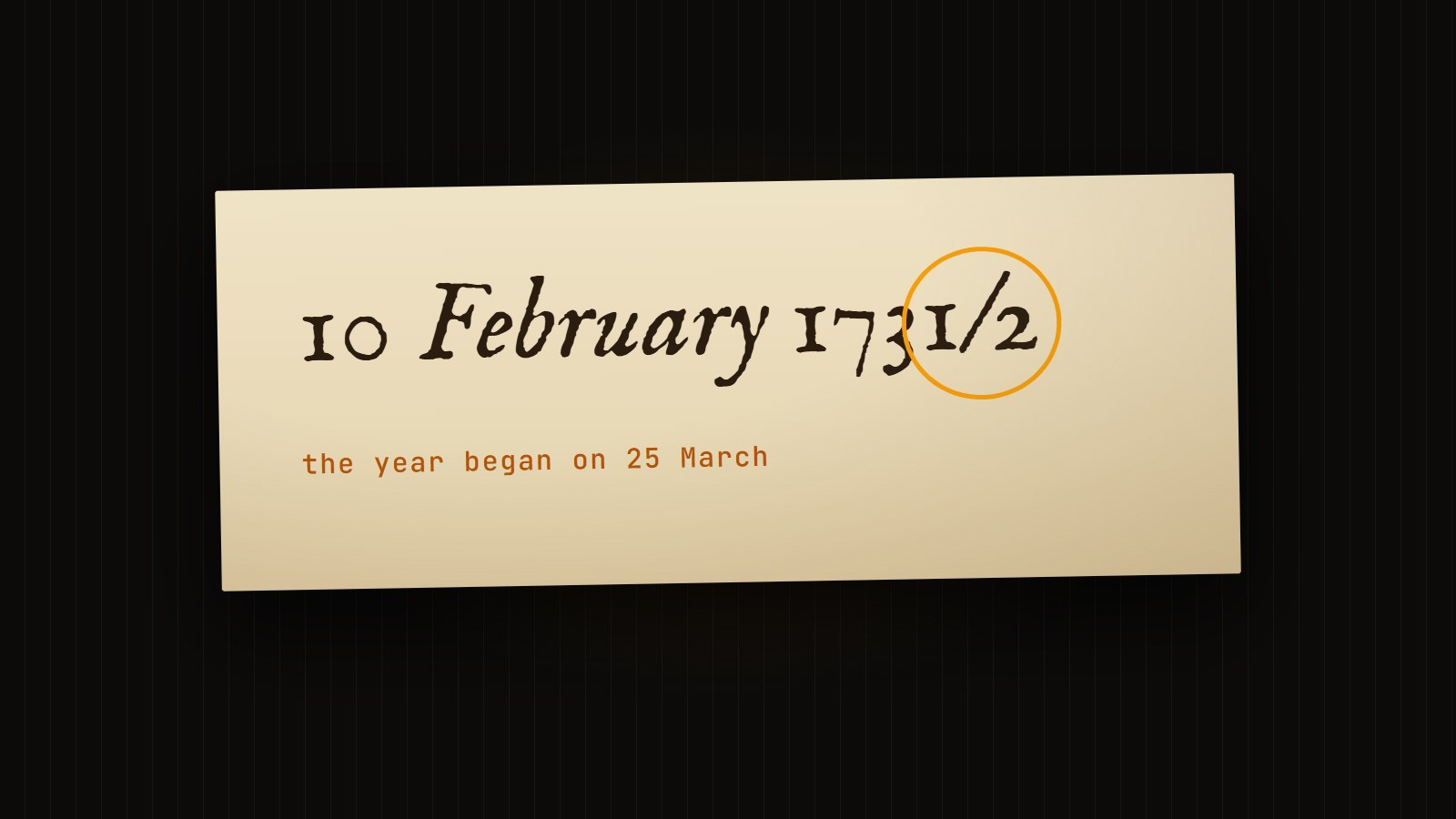
The case that matters most for English-language research: from 1155 to 1752, the civil year in England, Wales, Ireland and the American colonies began on 25 March. A birth on 10 February 1699 was, to everyone alive at the time, in the year 1699, but by our reckoning it falls in 1700. Scotland moved its year start to 1 January in 1600, one hundred and fifty-two years before it moved its day count, so Scottish and English documents from the seventeenth century can disagree about the year while agreeing about the day.
The practical rule for pre-1752 English-language records: any date between 1 January and 24 March belongs to the following year by modern reckoning. Add one to the year. Dates from 25 March to 31 December need no adjustment.
The best-known casualty is the execution of Charles I, recorded by Parliament at the time as 30 January 1648 and given in modern texts as 30 January 1649. No days were skipped; only the year start moved.
What does "1731/32" mean in a record?
It is called double dating or dual dating, and it is a scribe telling you he knows the year is contested.
Between roughly 1582 and 1752, educated English writers were aware that most of the continent had already moved New Year's Day to 1 January while England had not. For dates in the ambiguous window of 1 January to 24 March, they often wrote both years: 11 February 1731/32 means 1731 by the old English legal year and 1732 by the new. It does not mean "1731 or 1732, we are not sure." It means both, correctly, under two different conventions.
Two things follow.
Double dating only appears between 1 January and 24 March. If you see a slashed year on a date in July, something else is going on. Check whether you have misread the entry.
Record it, do not resolve it silently. The convention among archivists is to keep the day and month as written and give the year in the doubled form, 11 February 1731/32. Avoid writing it as 1731-32, which reads as a span of time rather than a single day.
George Washington is the standard illustration of what happens when only half the correction is applied. He was born on 11 February 1731 by the calendar in use in Virginia at the time. Converting properly requires adding eleven days and moving the year forward, which gives 22 February 1732. Apply one correction and not the other and you get 22 February 1731 or 11 February 1732. Both are wrong, and both are in print.
Records from the Russian Empire and Russian Poland
This is where English-language guidance thins out badly, and it is where researchers with Eastern European families spend their time.
The Russian Empire stayed on the Julian calendar until 1918. The Bolshevik decree of January 1918 deleted the Julian dates 1 to 13 February; Wednesday 31 January 1918 was followed by Thursday 14 February 1918. Every civil and church record produced in the Empire before that date is Julian. For the nineteenth century, add twelve days to get the Gregorian equivalent. Add thirteen only from 1 March 1900 onward, not from 1 January: a Julian date in January or February 1900 still takes twelve. The same off-by-one sits at the 1800 boundary. This is also why the October Revolution, dated 25 October 1917 in Russian sources, is commemorated in November.
Congress Poland is the exception, and it is a useful one. The Kingdom of Poland kept the Gregorian calendar for civil purposes even under Russian rule. Civil registration there began in 1808 under Napoleonic law and ran in Polish until 1867, and those acts use ordinary Gregorian dates written out in words. The Polish State Archives guide covers how that registration system worked.
From 1868, when the registers switched to Russian, the acts carry both dates. The standard form is the Julian date first, then the Gregorian, separated by a slash:
7/19 May 1869
7 May Julian, 19 May Gregorian, twelve days apart. The practice runs from about 1867 to 1915 and is one of the more reliable ways to confirm you are reading a Russian-partition act at all.
There is a trap inside it. A single act usually carries two dual dates, and they are not the same event. Napoleonic-form records open by stating when and where the act was drawn up, and then separately state when the birth or death occurred. Both are dual dated. A child born on 3/15 April can easily be registered on 8/20 April, and the act will show both pairs within a few lines of each other. Take the wrong pair and you have recorded the registration as the birth, which is the same error that produces phantom five-day-old newborns across half the trees on the internet.
Orthodox parishes are still Julian in many places. A revised calendar was proposed at a congress in Constantinople in 1923 and adopted piecemeal after it, by Constantinople, Greece, Cyprus, Romania and Poland in 1924, Alexandria and Antioch in 1928, and Bulgaria as late as 1968. The Russian, Serbian, Georgian and Macedonian churches, the Patriarchate of Jerusalem and Mount Athos stayed on the Julian calendar and are there still. The Orthodox Church of Ukraine moved only in September 2023, which is recent enough that most Ukrainian parish material you will handle predates it. That persistence is why Russian Orthodox Christmas falls on 7 January. If you are working with Orthodox parish registers, do not assume the state's conversion date applies to the church.
For the mechanics of reading these acts once you know which date is which, see the guides to Russian and Cyrillic records and Polish records.
The three Polish partitions, side by side
Because partition boundaries cut across families, it is worth seeing the calendar picture for all three at once. This is the same split that governs language, format and archive, covered in more depth in the guides linked below.
| Partition | Calendar in the records | Note |
|---|---|---|
| Russian (Congress Poland) | Gregorian 1808-1867, then both from 1868 | Julian date written first after 1868. See the Szukaj w Archiwach guide |
| Prussian | Gregorian throughout | These lands were Crown of Poland until the partitions, so they converted with the Crown in October 1582, Catholic and Protestant alike. See Prussian partition records |
| Austrian (Galicia) | Gregorian throughout the Austrian period | Habsburg lands converted in 1583-1584, long before the 1772 annexation. See Austrian Galicia records |
The Prussian row is the one people get wrong, because they reach for the German dates. Greater Poland, Royal Prussia, Mazovia and Warmia were Polish territory until the 1770s and 1790s, so their parishes followed the Crown into the Gregorian calendar in October 1582, not the Protestant Imperial Estates in 1700. The 1700 date belongs to Brandenburg and the other German territories, and Ducal Prussia, east of the partitioned lands, went in 1610. If your Poznań or Pomeranian register predates 1700, it is Gregorian.
Galicia is worth a sentence of its own. Greek Catholic parishes there followed the Julian liturgical calendar for feasts, but the metrical books they kept under Austrian administration are dated Gregorian like every other Austrian register. Liturgical practice and civil dating are two different questions, and Galician records are a good reminder that the answer to one does not give you the other.
What does "Dominica Cantate" mean on a baptism record?
It means the fourth Sunday after Easter, and which calendar date that was depends entirely on the year.
Church registers frequently dated entries by the liturgical calendar rather than by a number. Instead of "12 May," the clerk wrote the name of the Sunday or feast day. This is standard in German, Scandinavian and Latin parish books, is common through the eighteenth century, and persists with Catholic scribes into the nineteenth.
The notation is built from a small vocabulary:
- Dominica is Sunday. It is often abbreviated Dom.
- Feria numbers the weekdays, and the counting starts at Sunday. Feria II is Monday, Feria III is Tuesday, Feria IV is Wednesday, and so on to Feria VI for Friday. Sabbatum is Saturday. Reading Feria III as Wednesday is one of the most common transcription errors in Latin registers.
- ante means before, post means after, vigilia is the eve of, crastino is the day after, infra octavam means within the eight days following a feast.
So Feria III post Trinitatis is the Tuesday after Trinity Sunday. Dominica II post Epiphaniam is the second Sunday after Epiphany. Post festum Sancti Michaelis is after Michaelmas.
Fixed feasts and moveable feasts
Fixed feasts fall on the same calendar date every year, so they convert directly:
| Feast | Latin or German name | Date |
|---|---|---|
| Circumcision, New Year | Circumcisio Domini | 1 January |
| Epiphany | Epiphania, Heilige Drei Könige | 6 January |
| Candlemas, Purification | Purificatio Mariae, Mariä Lichtmess | 2 February |
| Lady Day, Annunciation | Annuntiatio Mariae, Mariä Verkündigung | 25 March |
| Midsummer, St John the Baptist | Nativitas Johannis Baptistae, Johanni | 24 June |
| Saints Peter and Paul | Petri et Pauli | 29 June |
| Lammas | Ad Vincula Petri | 1 August |
| Assumption | Assumptio Mariae, Mariä Himmelfahrt | 15 August |
| Michaelmas | Michaelis | 29 September |
| All Saints | Omnium Sanctorum, Allerheiligen | 1 November |
| All Souls | Omnium Animarum | 2 November |
| Martinmas | Martini | 11 November |
| Christmas | Nativitas Domini | 25 December |
These feasts are also worth knowing for a second reason. Several of them were quarter days and term days, the settling dates for rents, leases, hirings and debts. Manorial records, tenancy agreements and servant contracts cluster on Lady Day, Midsummer, Michaelmas and Christmas in England, and on Candlemas, Whitsunday, Lammas and Martinmas in Scotland. If a document is dated by one of those feasts, the date is telling you something about the kind of document it is.
Moveable feasts are computed from Easter, and Easter moves. These cannot be converted without knowing the year:
- The Sundays of Lent, in order: Invocavit, Reminiscere, Oculi, Laetare, Judica, Palmarum (Palm Sunday)
- The Sundays after Easter: Quasimodogeniti, Misericordias Domini, Jubilate, Cantate, Rogate, Exaudi
- Then Dominica Trinitatis, followed by the numbered Sundays post Trinitatis, which can run to twenty-seven
Those odd names are not saints. Most of them are the first words of the Introit sung on that Sunday. Cantate is "Sing", Laetare is "Rejoice", Oculi is "My eyes". Two are named another way and are worth flagging: Palmarum is named for the palms of Palm Sunday, and Rogate is named for the Rogation processions before Ascension, so it is listed in many conversion tables under its Introit, Vocem iucunditatis, instead. If you cannot find Rogate in a table, look for that.
How to actually convert one
Three steps, in this order.
- Establish the year and the calendar. A moveable feast in 1690 in a Lutheran parish is computed from Julian Easter; the same feast in a Catholic parish that year is computed from Gregorian Easter. They are not the same Sunday.
- Look up that year in a feast-day table. FamilySearch publishes moveable-feast calendars organised by year, Julian for 1501 to 1812 and Gregorian for 1583 to 1900, so check you are in the right series before you read off a date. For German-language material the standard reference is Grotefend's Taschenbuch der Zeitrechnung, which is available free online in a digital edition.
- Read the modifier last. Get the anchor feast first, then apply post, ante, feria or vigilia. Doing it in the other order is how a Tuesday becomes a Thursday.
One more caution that applies to every church register regardless of dating style: the date on the entry is usually the date of the rite, not the date of the event. A baptism is not a birth and a burial is not a death. Where the register gives both, record both. Where it gives one, say which one it is.
Kalends, Nones, and Ides in Latin records
Early parish registers, wills, deeds, charters and episcopal records often use the Roman dating system. It looks impenetrable but is mechanical.
Three anchor days in each month:
- Kalendae, the Kalends, is always the 1st.
- Nonae, the Nones, is the 5th, except in March, May, July and October, where it is the 7th.
- Idus, the Ides, is the 13th, except in March, May, July and October, where it is the 15th.
Every other day is counted backwards to the next anchor, and both ends of the count are included. The anchor itself is day one. Dates are written ante diem, abbreviated a.d., plus a Roman numeral, plus the anchor and the month. The day immediately before an anchor is not "a.d. II" but pridie.
Worked through:
- a.d. IV Kalendas Apriles. Count back from 1 April: 1 April is I, 31 March is II, 30 March is III, 29 March is IV. The date is 29 March.
- pridie Idus Martias. The Ides of March is the 15th, so the day before is 14 March.
- a.d. III Nonas Ianuarias. The Nones of January is the 5th: 5 January is I, 4 January is II, 3 January is III. The date is 3 January.
There is one wrinkle worth knowing. The Julian leap day was not 29 February. It was 24 February counted twice, ante diem bis sextum Kalendas Martias, the sixth day before the Kalends of March taken a second time. That is where the word bissextile comes from, and in a leap year a document may be dated dies bissextus.
Latin registers also frequently combine a Roman-style date with a feast day or a regnal year in the same line, which is why these systems are worth learning together rather than separately. Our guide to Latin parish records covers the surrounding vocabulary.
Quaker records: which month is the twelfth month?
It depends entirely on whether the record is before or after 1752. The two schemes are two months apart, so every misread date lands in the wrong month, and for the high-numbered months it lands in the wrong season and often the wrong year as well.
The Society of Friends rejected the names of months and weekdays because they derive from Roman and Norse gods. Quaker records therefore use numbers: First Day for Sunday, and First Month, Second Month and so on for the months.
The problem is that the numbering was anchored to the legal year, which in England began on 25 March.
| Written in the record | Before 1752 | After 1752 |
|---|---|---|
| First Month | March | January |
| Tenth Month | December | October |
| Eleventh Month | January | November |
| Twelfth Month | February | December |
"The 10th day of the 12th month" is 10 February in a 1740 record and 10 December in a 1760 one.
And because February falls in the 1 January to 24 March window, the pre-1752 reading also needs the year corrected, so that entry is properly recorded as 10 February 1740/41. The Latin month names confirm that this numbering is not eccentric: September, October, November and December literally mean the seventh, eighth, ninth and tenth months, which is only true if the year starts in March.
Practice was not perfectly uniform, and some meetings moved to a January year start before 1752. Records from the 1740s and early 1750s deserve a second look rather than a rule.
"In the twelfth year of the reign of" and other regnal dates
English and British legal documents, and many church and manorial records, are dated by the year of the sovereign's reign rather than by the calendar year. A deed might read anno regni regis Henrici octavi vicesimo, the twentieth year of the reign of King Henry VIII.
Regnal years run from the anniversary of accession, not from 1 January, so they straddle two calendar years. Henry V acceded on 21 March 1413, so 1 Henry V runs from 21 March 1413 to 20 March 1414. A regnal date alone does not give you a calendar year; you also need the month.
Two complications are worth flagging. Because regnal years do not align with calendar years, a moveable feast such as Easter can occasionally fall twice within one regnal year. And King John is a special case entirely: his regnal years were counted from his coronation, which fell on Ascension Day, itself a moveable feast, so his regnal years vary in length.
For anything before 1752 you have to resolve the regnal year and the 25 March year start together. C. R. Cheney's A Handbook of Dates for Students of British History is the standard printed reference, and several free online regnal-year converters will do the arithmetic.
Hebrew dates in Jewish records
Jewish records, gravestones and community registers use the Hebrew calendar, often alongside a civil date and sometimes instead of one. Four things about it change how you record a date.
The day begins at sunset. A Hebrew date does not map to one civil date. It covers the evening of one civil day and the daylight of the next. A stone reading 6 Elul 5710 corresponds to the night of 18 August or the day of 19 August 1950. Unless the record states a time, both civil dates remain possible, and deaths recorded in the evening are the classic case. Converters that ask whether the event was before or after sunset are asking a real question, not being pedantic.
Years are written in letters, and the thousands are usually dropped. Hebrew numerals are formed by adding letter values. On gravestones the five thousand is normally omitted, a convention marked by the abbreviation לפ״ק, meaning "by the small reckoning." So תש״פ is 400 plus 300 plus 80, which is 780, and the year is 5780. Add 5000 unless the context makes another reading obvious. The mark before the final letter signals that the string is a number rather than a word.
Leap years double the month of Adar. Seven years in every nineteen have a thirteenth month, and the doubled month is Adar, giving Adar I and Adar II. A record that says only "Adar" in a leap year is ambiguous. The anniversary of a death that fell in a plain Adar is observed in Adar I by Ashkenazi custom and in Adar II by Sephardi custom, with some families keeping both, so a memorial date and a death record can disagree by a month without either being wrong.
Dates may be given by holiday rather than by number. "The second day of Passover" is a date, and it needs the same year-specific lookup that a Christian moveable feast does.
There is an upside to all this. Where a family appears with conflicting civil dates across several records, a Hebrew date is often the tiebreaker, because it was recorded by the community rather than by a state clerk working from a report several days late. It is worth extracting the Hebrew date even when a civil date is present. See the guides to Hebrew records and Yiddish records for reading the surrounding text.
Three more calendars you may meet
The French Republican calendar has twelve thirty-day months named for the seasons, from Vendémiaire to Fructidor, plus five extra days at the end of the year, six in a leap year, called the jours complémentaires. Dates do fall in those five days and they do appear in registers. Note the two different dates attached to it: the era is counted retroactively from 22 September 1792, but the calendar was only decreed in October 1793 and settled in its final form that November, so French civil registers from late 1792 through most of 1793 carry ordinary Gregorian dates. It was abolished with effect from 1 January 1806. It appears in French civil registration and in the registers of territories under French rule at the time, including Belgium, Luxembourg, the Rhineland, parts of the Netherlands and parts of Italy. A date such as 18 Brumaire An VIII needs a proper converter; there is no arithmetic shortcut.
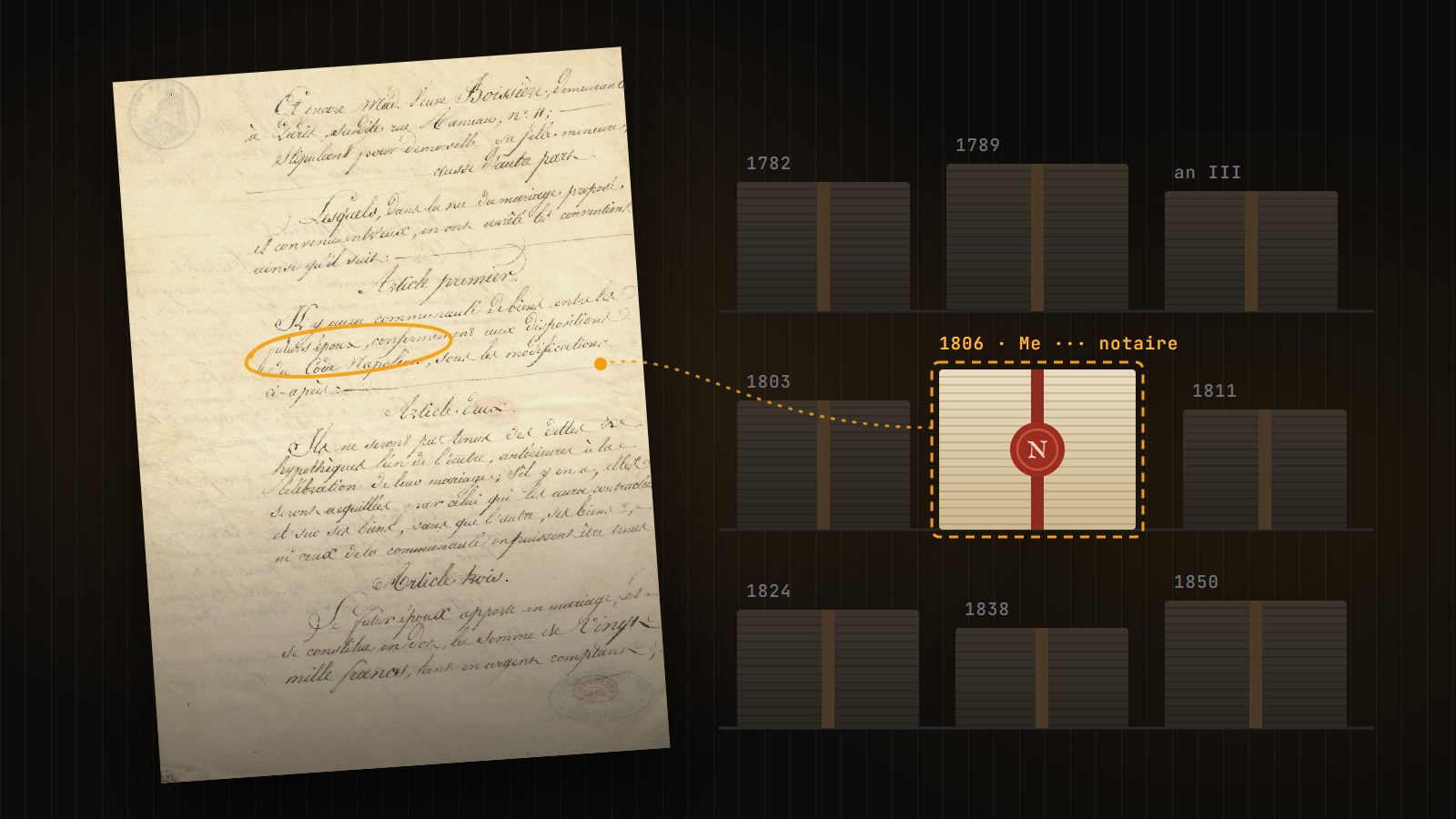
It is worth clearing up a related confusion. Civil registration in the Duchy of Warsaw, and later Congress Poland, was created by decree in January 1808 and took effect that May, more than two years after the Republican calendar had been abolished. Those registers are Napoleonic in form, with the long narrative Działo się paragraph borrowed from the Code Napoléon, but they are dated in ordinary Gregorian style. Napoleonic format does not imply a Revolutionary calendar.
The Ottoman Rumi calendar was a Julian-based solar calendar counting from the Hijri era, used for civil and fiscal purposes from 1840. Its day count was aligned to the Gregorian calendar in 1917, and the Gregorian era replaced it entirely from 1 January 1926. Rumi years run 584 behind Gregorian ones, so Rumi 1333 is 1917, and an Ottoman civil document needs both a day correction and an era correction.
The Islamic Hijri calendar is purely lunar, with years of 354 or 355 days, so it drifts against the solar year by about eleven days annually. There is no fixed offset. Hijri dates must be converted with a table or a calculator, never by subtraction.
How to record a date you are not certain about
This is the part that determines whether the research holds up in five years.
Record the date as the document states it. The transcription should be able to reproduce the original line, before any conversion of yours. If the act says 7/19 May 1869, that is what belongs in the transcription.
Record which calendar it is in. A date without a calendar is an unfinished citation. "12 March 1885, Julian, as written" is a fact. "12 March 1885" is a guess wearing a fact's clothing.
Record the conversion separately, and label it. Keep the original and the converted date as two distinct pieces of information. If you later discover the parish was on a different calendar than you assumed, you can redo the conversion. If you overwrote the original, you cannot.
Keep the doubled year doubled. 11 February 1731/32 is more informative than either 1731 or 1732, and it tells the next researcher that you understood the problem.
Say whether the date is the event or the record: baptism or birth, burial or death, registration or event. In dual-dated Russian-partition acts, in feast-dated church books, and in late-registered civil records, this distinction moves dates by days or weeks and is the difference between a timeline that makes sense and one that does not.
If you export your research, this is also where GEDCOM will let you down without warning. The format has a date structure, but calendar qualifiers and dual years survive transfer between programs unevenly. Keep the original wording in a note attached to the source, not only in a date field, so the evidence travels with the data.
Where the software can help, and where it cannot
Handwriting models are strongest on the formulaic parts of a record, and dates are formulaic. Reading Feria III post Trinitatis or a Cyrillic седьмого / девятнадцатого мая off a page is mechanical work worth handing over.
In KleioBase, a scan processed through the upload workspace is transcribed and translated with the date left as the record wrote it, then extracted into structured fields that feed the knowledge base and the timeline. Filling in the Context box before processing matters more here than almost anywhere else: telling it the parish, the denomination, the year and the language is what lets a date be read as a date rather than a string of numerals. If you know the register is a Lutheran book from 1690, say so.
A date recorded in another calendar in your knowledge base, whether you set it on a date field or it arrived in a GEDCOM file, stays in that calendar. A Hebrew, Julian or French Republican date is held and displayed as the register wrote it, with the Gregorian equivalent offered on request rather than substituted for it. The conversion is used behind the scenes only where two dates have to be compared: ordering a timeline, working out an age, deciding which century of history to show alongside a life. Changing a date's calendar converts it properly, offset and all, and the French Republican calendar is handled for the fourteen years it was in use rather than extrapolated past them. Dates and Calendars covers what a date field can hold.
The Research Companion will also take an attached scan and answer a direct question about it, which is useful when the only thing you need from a page is the dating line:
This is a Latin Catholic baptism register from Bohemia, 1698. Transcribe the date formula for each entry on this page exactly as written, and tell me which are feast-day dates and which are numbered dates.
What no tool should be doing is silently converting. A conversion depends on the denomination of the parish, the territory, the year, and whether the entry records the rite or the event. Those are facts about the record that you supply. The reasonable division of labour is that the machine reads what is on the page and preserves it, and you decide what it means. That is the same boundary that applies to everything else AI does in genealogy.
Quick reference
| Term | Meaning |
|---|---|
| O.S. / N.S. | Old Style (Julian) / New Style (Gregorian) |
| Double dating | Both years given for a date between 1 Jan and 24 Mar in pre-1752 English records, as in 1731/32 |
| Lady Day | 25 March, the start of the English legal year until 1752 |
| Dominica | Sunday |
| Feria II, III, IV | Monday, Tuesday, Wednesday |
| ante / post | before / after a named feast |
| vigilia / crastino | the eve of / the day after |
| Kalendae, Nonae, Idus | 1st; 5th or 7th; 13th or 15th of the month |
| pridie | the day immediately before an anchor day |
| bissextus | the doubled 24 February of a Julian leap year |
| לפ״ק | Hebrew years given without the thousands |
| Adar I / Adar II | the doubled month in a Hebrew leap year |
| An VIII, Brumaire | French Republican year and month |
Start with the calendar, not the number
Nothing in this article requires you to memorise a conversion table. It requires one habit: before you write a date into your tree, know what system the clerk who wrote it was working in.
That is a small question with a specific answer. Which territory, which denomination, which year, which language. Once you have those four, the calendar follows, the conversion follows, and the date you record is a claim you can defend rather than a number you copied.
Records that survived four hundred years of war, partition and reorganisation deserve better than to be filed under the wrong year because 1752 removed eleven days and 1868 added a slash. The handwriting is the wall most researchers notice. The calendar is the one they walk into.
Follow KleioBase on Google
Add us as a preferred source to see our research guides more often in Google Search and AI results.
Start building your family history
Upload a record and let KleioBase transcribe, translate, and connect it - all in one place, with a research partner that remembers everything you find.
Get started