You found the grave. Maybe it took a drive to a churchyard three counties away, or a volunteer's photograph on a cemetery website, and there is the name, with a birth date and a death date cut into the stone. It feels like the most solid evidence you have. Paper burns and gets misfiled, but a stone stays where it was put.
Then the death certificate arrives with a different year on it.
The stone may still be the one that is right, but the question to ask of it is the one you would ask of any other record. Who supplied these dates, and when? A gravestone is a document. A family member or a friend gave the carver the details, sometimes within weeks of the death and sometimes decades after it, and the stone records what that person knew on the day it was ordered.
The short answer. The dates on a gravestone are usually close to right, but they are secondhand evidence, written down by whoever paid for the stone and at whatever date it went up. In a study of County Louth memorials that state the year they were erected, the archaeologist Harold Mytum found that most outdoor memorials went up within a decade of the latest death they record, and that stones erected earlier or later than that were relatively common in the 18th century and rare in the 19th. A stone can be a later replacement, can be carved before the death, or can be paid for decades afterwards by relatives abroad, and each of those can put a wrong date into the stone. Most of the dead never had a stone at all: one Leicestershire study found that on average only 8.23 per cent of people in the burial registers were named on a surviving monument. Treat a stone as a lead, and test its dates against records made at the time.
A gravestone records what someone knew on the day it was ordered
A stone was not cut at the graveside. Someone had to choose it, pay for it and tell the mason what to carve, and that took time.
Most stones went up within ten years. Mytum's paper, "The dating of graveyard memorials: evidence from the stones", published in Post-Medieval Archaeology in 2002, looked at a group of memorials in County Louth, Ireland, that carry their own date of erection, and compared it with the latest date of death in each stone's main inscription. He concluded that most external memorials can be dated to within a decade of that latest death, but that some were put up earlier or later, and that those exceptions were relatively common in the 18th century before becoming rare in the 19th.
A decade is long enough for details to drift. The widow who knew her husband's birthday may have died before the stone was ordered, and the son who placed the order may have been working from memory or from a family Bible.
Some stones are much later than they look. Ireland Reaching Out's guide to Irish gravestones, published in October 2020, says that upright headstones were rare in Ireland before the 19th century, and that a headstone for an early 19th-century ancestor in excellent condition is likely a modern replacement put up by a later generation. It adds that a legacy from overseas often led to a headstone being erected long after the death, which can produce errors such as dates that do not match. An emigrant who did well and paid for a stone at home was paying for what the family remembered, at the time they paid.
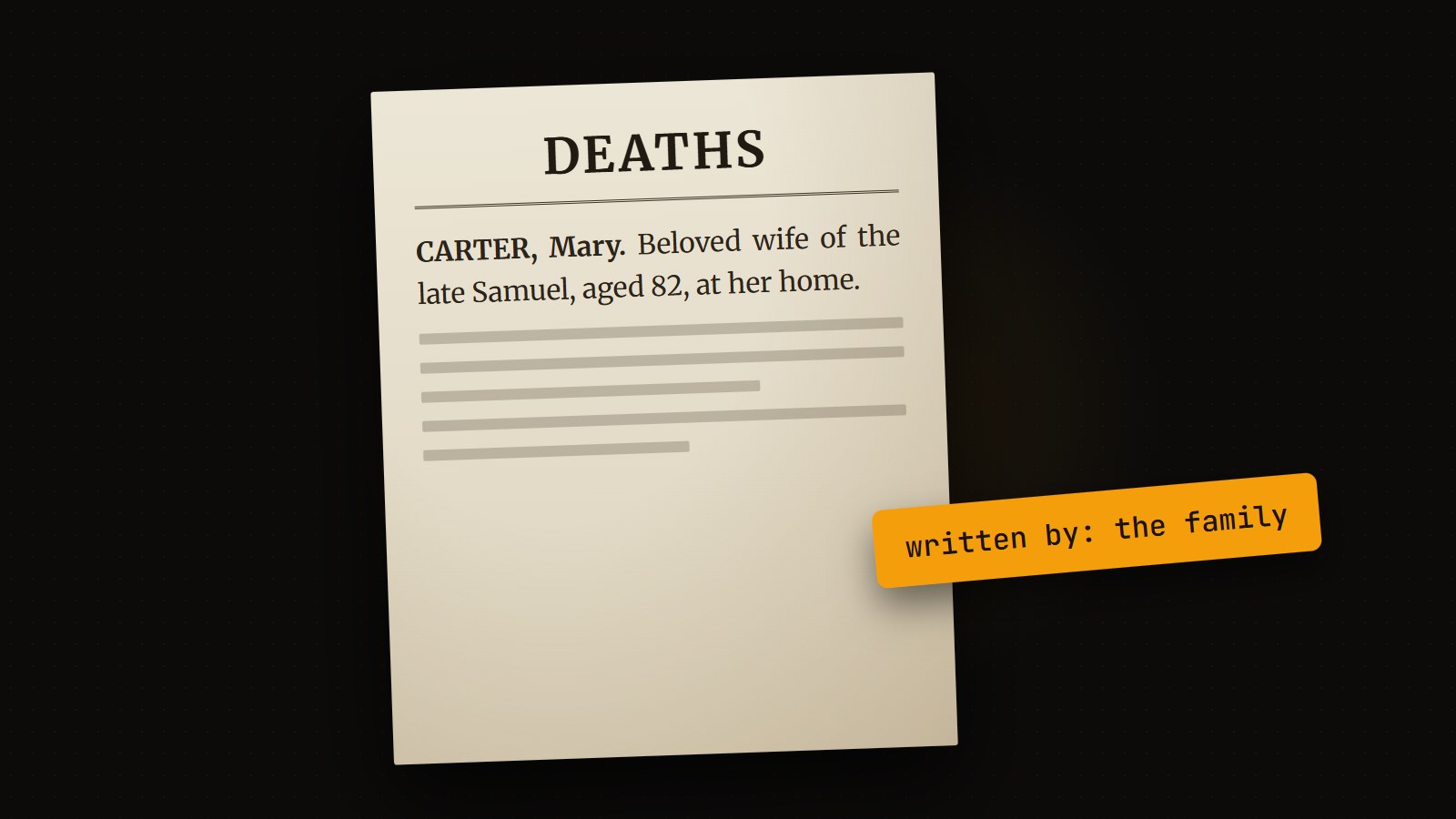
The informant problem is the same as on paper. On a modern death certificate in the United States, the personal details come from an informant. The Centers for Disease Control and Prevention's Funeral Director's Handbook, in its 2019 revision, says that in most cases the informant is a member or friend of the family, and that their name and relationship must appear on the certificate. A gravestone has an informant too, but it rarely names them. If the family member who sat with the funeral director also ordered the stone, the certificate and the stone may be the same memory recorded twice. We made the same point about how accurate an obituary is, where the notice and the certificate are often filled in by one person in the same week.
Some stones were carved before the death they record
Mytum also found stones that went up before the last death they record. A stone like that can carry a date that never happened.
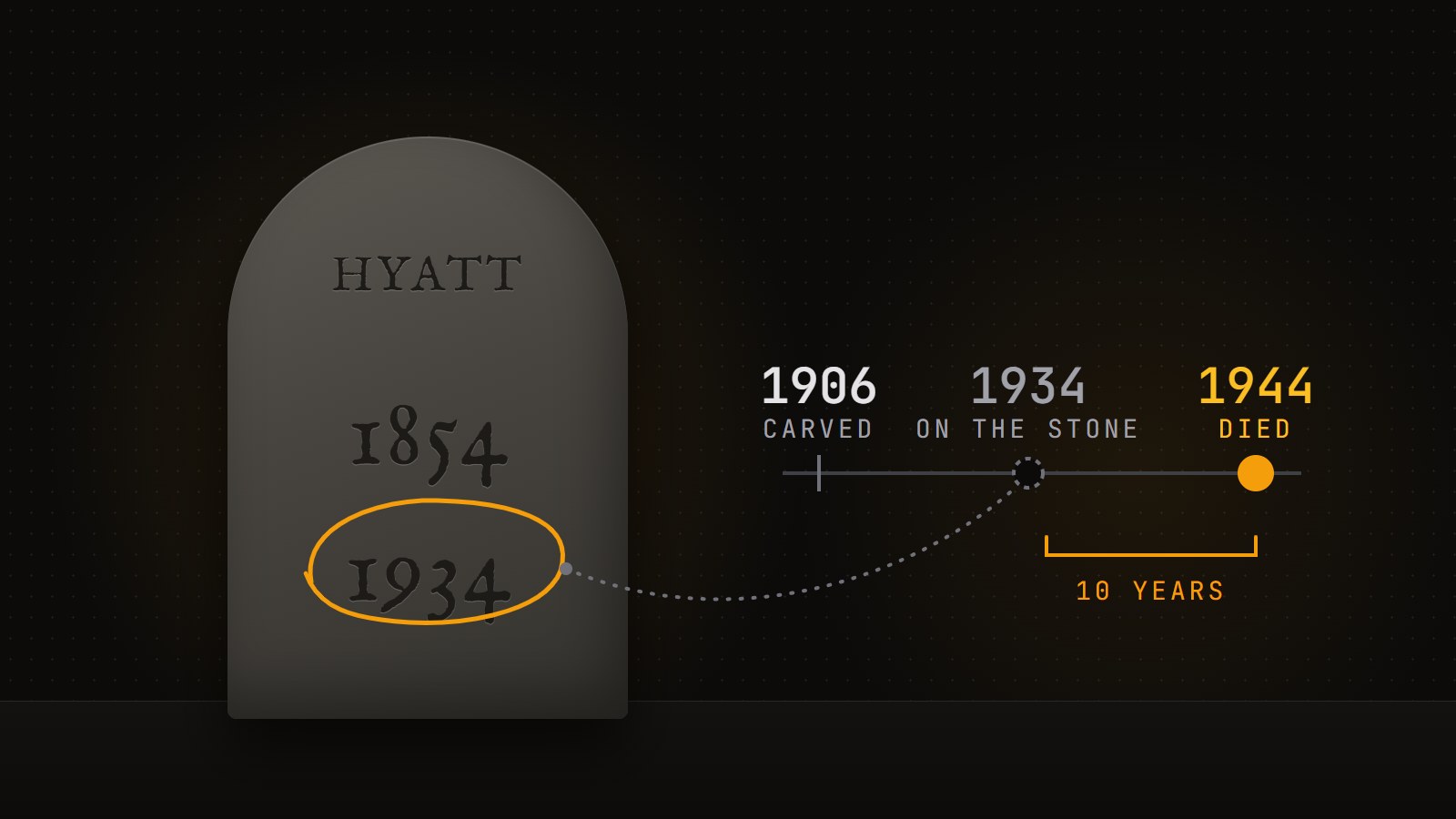
FamilySearch's blog told one such story in 2015. Willard O. Hyatt of Burlington, Calhoun County, Michigan, had a tombstone showing that he died in 1934. His Michigan death certificate disagreed. A newspaper story explained why. Both of Willard's parents had died at 80, and he expected to do the same. In 1906 he bought his tombstone and had the carver cut his life dates as he expected them to be, 1854 to 1934. He died on 28 October 1944.
Willard's case is unusual because he chose his own death year. But any stone erected before the last death it records was lettered with what someone expected or believed at the time, and that is reason enough never to let a stone be the only evidence for a death.
Most of the dead never had a stone
Before you weigh what a stone says, remember how few people had one.
In Leicestershire, about one in twelve. The University of Leicester Graveyards Group compared the number of people named on surviving monuments in a set of historical burial grounds with the number recorded as buried in the parish registers, and published the result in Post-Medieval Archaeology in 2012 as "Frail memories: is the commemorated population representative of the buried population?". Across the graveyards they studied, the mean proportion of registered burials who were also commemorated was 8.23 per cent. It varied considerably, and it was much higher in rural graveyards and much lower in urban ones.
Other places look different. The Discovering England's Burial Spaces project, run from the University of York with Historic England among its partners, notes in its guidance that data from Pembrokeshire suggests a high rate of commemoration while the Leicestershire data shows a much lower one, and that very few such studies have been completed. There is no national figure to apply to your parish.
Children are the most likely to be missing. The same guidance says that children are generally very under-represented on memorials when they can be compared with burial registers, and that infants were often only counted on a family stone, as "also two infants", or named without any other details.
In Ireland, unmarked graves were normal for a long time. Ireland Reaching Out says that most people who died in Ireland up to the 18th century lie in unmarked graves, and that civil registration of deaths did not begin there until 1864.
So an empty search of a churchyard is weak evidence that a person is not buried there. Record it as negative evidence, with the burial ground and what you searched, and look for the burial register instead.
The age on a stone has its own source
Ages are the weakest figures on most stones, and historians have studied the problem on Roman tombstones.
Who commemorated whom shapes what was carved. Keith Hopkins, in "On the probable age structure of the Roman population", published in Population Studies in 1966, looked at the ages at death given on the many thousands of surviving Roman tombstones that earlier scholars had used to calculate life expectancy. He found the distribution demographically most improbable, and explained it by the patterns of commemoration between relatives. Some inscriptions give an age, some record a relationship such as a marriage instead, and some give both. His conclusion was that the distortions cannot be corrected, and that these ages must be discarded as evidence for life expectancy. That is a finding about a population, not about your stone, but the mechanism carries over. What was carved depended on who was doing the commemorating and what they chose to record.
On war graves, the age came from the family's form. The Commonwealth War Graves Commission explains that after both world wars it posted Final Verification forms to the next of kin named by the service authorities, and that the forms carried details the family supplied, such as their chosen personal inscription, religious emblem and the age of the person who died. It used them to check its own records and to make sure the right information was engraved. The Commission's headstone schedules record the date of death and age as inscribed. So the age on a Commonwealth war grave is often the family's statement, not the army's. For the First World War you will rarely see the form itself, because the Commission says about 99 per cent of those forms were destroyed during the Second World War. The Long, Long Trail, a research guide to the British Army in the First World War, notes that army records were not always accurate on ages, because many men's ages were falsified, which is part of why the family was asked.
On Jewish stones, convert the Hebrew date yourself. JewishGen's guide to reading Hebrew tombstones, by Warren Blatt, explains that a Hebrew inscription gives the date of death in the Jewish calendar, sometimes the age or date of birth, and the given name of the person's father, which takes you back a generation. Converting the year needs care. The guide says the Hebrew year begins at Rosh Hashanah in September or October, so dates in Tishri, Heshvan, Kislev and sometimes Tevet belong to the earlier civil year. If a stone carries both a Hebrew and a civil date and they disagree, work out the conversion yourself before you decide which one the family got wrong. Our guide to reading dates in old records covers the Hebrew calendar in more detail.
A transcription is a copy of a copy
Many researchers never see the stone itself. They see a volunteer's transcription, a society's printed list of monumental inscriptions, or a photograph online.
Each of those adds a step. The Discovering England's Burial Spaces guidance warns that inscriptions may have eroded and memorials may have been removed, and suggests using older transcripts to fill the gaps. An older transcript may preserve a date that has since worn away. It may also be where a 3 was first read as an 8. If the transcription and the photograph disagree, trust the photograph, and if the photograph is unclear, note both readings.
We could not find a published study that measures how often gravestone dates disagree with the civil or church records for the same person. Searches for one turned up forum threads, blog posts and the studies above, which measure when stones went up and who was commemorated. None of them counts how often the dates are wrong, so treat any percentage you see quoted as a guess.
How to weigh what a gravestone says
The method below is ours, built on the studies above.
| On the stone | Likely supplied by | Check it against |
|---|---|---|
| Date of death | Whoever ordered the stone, usually close family | Civil death registration, burial register, death notice |
| Age at death | The same person, often working back from memory | Baptism, earliest census entries |
| Date of birth | The same person, furthest from the event | Baptism or birth registration |
| Father's name (Jewish stones) | The family, as part of the Hebrew name | Marriage and birth records naming the parents |
| A second name added later | Whoever paid when the second person died | That person's own death and burial records |
Date the stone, not just the death. Look for a date of erection, a stone that names someone who died much later than the first person, or a style that looks newer than the death it records. Any of them means the inscription may have been cut years later, from memory.
Look for who paid. Some stones say who erected them, and that person is your likely informant. A stone in the Church of Ireland graveyard at Edrim, Killymard, in County Donegal, transcribed on the Donegal Genealogy website, reads "Erected by Elizabeth Buchanan In Memory of Her Beloved Father James Buchanan Who died 19 Mar 1889 Aged 92 years". That 92 is most likely his daughter's statement, and worth testing against a baptism. A stone put up by a grandson in 1890 for a man who died in 1840 is the grandson's knowledge, not the dead man's.
Rank the dates by distance. The death date is usually the best thing on a stone, because the person ordering it was nearest to that event. The birth date and the age are furthest away and most likely to be estimated. A full day, month and year is a little more reassuring than a year alone, but it is still what the informant believed.
Compare with records made at the time. A baptism written days after the birth, a census taken while the person was alive, a civil death registration and a burial register entry were all made by other people at other times. If the stone agrees with them, good. If the only thing it agrees with is the death certificate, check whether the same family member supplied both. Our piece on how accurate family stories are explains why names, exact numbers and ages are the details most likely to drift as a family retells them.
Keep both dates. When the stone and a register disagree, record both, with where each came from, rather than overwriting one with the other. The difference may be the clue. It could be a burial date carved as the death date, a birth year worked back from a rounded age, or a stone ordered in advance.
What KleioBase does with a gravestone, and what it does not
We are a tool in this space, so read this as disclosure.
KleioBase is an AI research companion that turns scattered historical records into one connected family archive. A gravestone fits that well, because most of its value lies in whether it agrees with the burial register, the death certificate, the census and the obituary.
Upload a photograph of the stone as a JPG or PNG, or a page of transcribed inscriptions as a PDF, and the people, dates, places and relationships are extracted for you to review before anything is saved. Each record stays a fixed snapshot of what its document said, while the person's profile holds your conclusion, so a stone that says 1934 and a certificate that says 1944 can both sit on Willard's profile without one replacing the other. If you add a second death or burial date to a person, KleioBase keeps it and raises a Same Life Event Recorded Twice conflict so you decide which is right. A Hebrew date on a Jewish stone can be kept in the Hebrew calendar and converted when you want it, as the dates and calendars guide explains. If you are not sure the stone belongs in your tree yet, attach the photograph to a conversation with the Research Companion and ask about it first.
There are three honest limits.
It does not know when the stone was carved. It reads the inscription you give it. Working out that a stone is a replacement, or was bought in advance, is your judgement.
It can only read what the photograph shows. If a digit has worn away or the light was wrong, it cannot recover what the photograph does not show. Photograph the stone with the light falling across its face from one side, and keep a note of any digit you are unsure of.
It will not tell you a stone exists. On the Researcher plan and above, Expected records suggests missing death and burial records for a person, but not gravestones in particular, and it cannot know which churchyard to search. A search of a burial ground that found nothing can be recorded against the person, with the place and what you looked at.
Where to start with the stone you already have
Take one gravestone in your research and write down every date and age on it.
Next to each, note who was alive to supply it when the stone went up, and whether the stone gives any sign of when that was.
Then find one record made at the time for each date, such as the burial register for the death and a baptism or the earliest census for the birth. Where they disagree, keep both and note which is closer to the event.
The people who ordered these stones wanted their dead remembered by name in a place their neighbours would pass. They wrote down what they knew, at the price they could afford, and often years after the funeral. Read the stone as their testimony, and it will tell you a great deal about the family who were left.
Follow KleioBase on Google
Add us as a preferred source to see our research guides more often in Google Search and AI results.
Start building your family history
Upload a record and let KleioBase transcribe, translate, and connect it - all in one place, with a research partner that remembers everything you find.
Get started